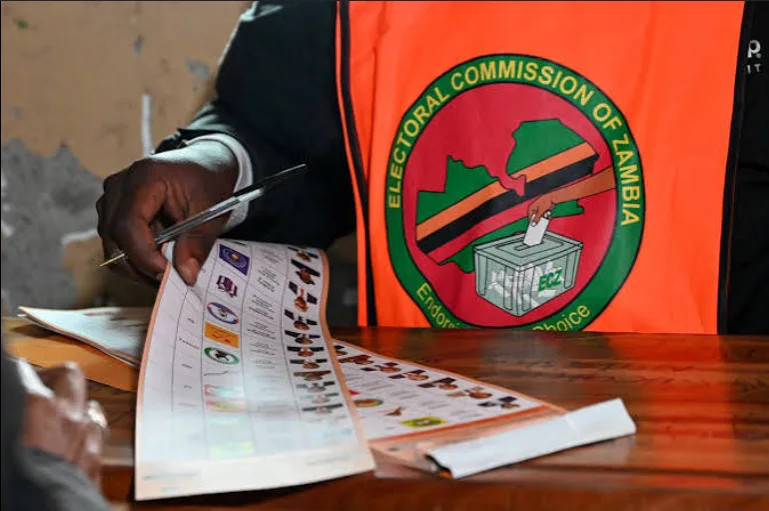
Zambia’s closely watched general election has entered a tense and politically sensitive stage, with regional and international observers calling for restraint as the country waits for official presidential and parliamentary results.
On 15 August 2026, international election observation missions released their preliminary assessments of the vote held on 13 August, urging political parties, candidates and their supporters to remain peaceful and allow the Electoral Commission of Zambia (ECZ) to complete the results process.
The intervention comes after an unusually turbulent period during vote counting.
Violence disrupts the counting process
The ECZ temporarily suspended counting after election officials were attacked and ballot papers were stolen in incidents that raised immediate concerns about security surrounding the election.
Counting subsequently resumed after authorities said the security threat had been addressed.
The interruption is significant because confidence in an election depends not only on what happens inside polling stations but also on whether ballots can be transported, counted and reported without intimidation or interference.
Authorities are therefore under pressure to demonstrate that the disruption has not compromised the integrity of the national result.
Electoral Commission warns against premature victory claims
Another political challenge has emerged before the final results are announced.
ECZ chairperson Mwangala Zaloumis warned candidates against declaring themselves winners before the commission completes the official tally, stressing that premature victory declarations are unlawful.
The warning came after opposition challenger Brian Mundubile claimed victory without providing evidence, according to Reuters.
President Hakainde Hichilema, who is seeking another term, has instead urged supporters to remain calm and wait for the official outcome.
This period can be one of the most dangerous stages of a closely contested election.
Unofficial victory declarations can encourage competing groups of supporters to believe their candidate has already won, potentially increasing tensions when official results eventually differ.
International observers step in
Election observation missions deployed to Zambia have now issued their preliminary statements.
Their message emphasizes allowing the Electoral Commission to finish its work while political actors use established legal and institutional channels to address complaints.
That international attention reflects Zambia's importance as one of southern Africa's more closely watched electoral democracies.
The country has previously experienced peaceful transfers of presidential power, giving it a democratic reputation that extends beyond its borders.
The events surrounding the 2026 election are therefore being watched as a test of whether those institutions remain resilient under political pressure.
More than Zambia’s presidency is at stake
The election has significance beyond determining who governs Zambia.
The country is an important producer of copper and other critical minerals, giving its political direction increasing international economic and strategic importance as demand for minerals used in renewable energy, electric vehicles and advanced technology grows.
The next government will also inherit major questions involving economic development, debt, foreign investment and Zambia's relationships with international partners.
That gives the election consequences extending well beyond domestic party politics.
The decisive moment is approaching
Preliminary constituency-level information has circulated, but the Electoral Commission has not yet announced the final national presidential result. Reuters reported that official results are expected on Monday.
Until then, restraint from both political camps will be critical.
Election disputes become particularly dangerous when unofficial claims spread faster than verified results. Zambia's institutions now face the challenge of completing the count transparently while maintaining public confidence.
Why this matters
The major political development on 15 August 2026 is therefore not simply another campaign announcement.
Zambia is navigating the decisive aftermath of a national election following violence against election officials, stolen ballots, a temporary interruption of counting and competing political pressure over the outcome.
International observers are now publicly urging calm while the Electoral Commission finishes the process.
The next few days could determine more than Zambia's next government. They will also test whether the country's electoral institutions can resolve a highly charged contest peacefully and preserve public confidence in the democratic process.