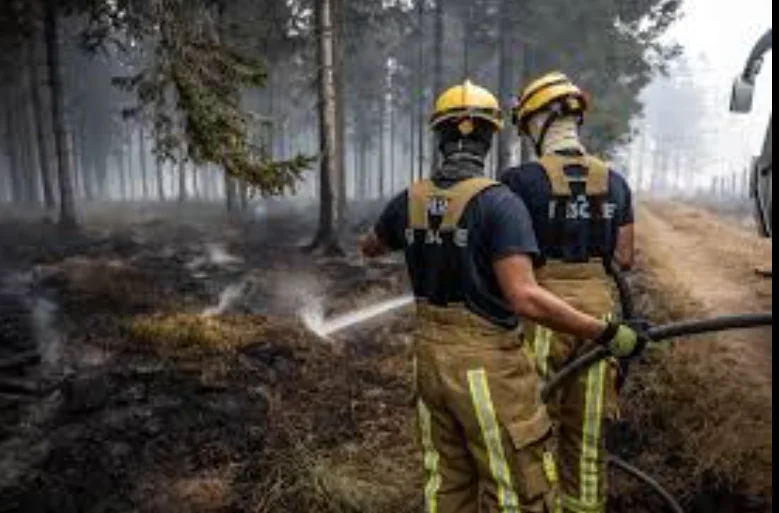
The European Union has launched an emergency cross-border response in Belgium, deploying firefighting aircraft as the country struggles to contain a record wildfire that has forced residents from threatened communities.
The EU sent three helicopters and two water-bombing aircraft to support Belgian firefighters on Saturday, 15 August 2026, according to the bloc's crisis commissioner.
The intervention represents a significant use of Europe's collective emergency-response capabilities at a time when extreme heat and wildfires are putting growing pressure on governments across the continent.
EU activates international firefighting support
Belgian emergency services are confronting a fire serious enough to require assistance beyond the country's own firefighting resources.
The deployment of helicopters and specialized water-bombing aircraft gives crews additional capacity to attack flames from the air, particularly in locations where ground teams may struggle to operate safely.
European cooperation becomes particularly important during large natural disasters because individual countries can quickly exhaust their available emergency resources.
The EU's response allows equipment and personnel to be mobilized across national borders when a member state faces an emergency beyond its normal capacity.
Residents ordered to evacuate
The situation has become serious enough for authorities in some eastern Belgian villages to tell residents to leave their homes.
Evacuations indicate that authorities believe the fire could directly threaten populated areas.
Wildfires can change direction rapidly as wind conditions shift, leaving communities with relatively little time to escape.
Authorities therefore face a difficult decision: waiting too long can put lives at risk, while evacuating large populations requires transportation, temporary accommodation and emergency support.
Belgium confronts a record fire
The scale of the blaze makes the emergency particularly significant.
Reuters describes it as a record wildfire in eastern Belgium, an unusual development for a country that historically has not experienced wildfires on the scale associated with parts of southern Europe.
That could have important implications for European climate and emergency policy.
Countries such as Greece, Spain, Portugal and Italy have long invested heavily in wildfire preparedness because severe summer fires occur regularly.
Northern European countries may increasingly need to strengthen similar capabilities if extreme fire conditions become more common.
Climate adaptation becomes a political challenge
The immediate priority is protecting lives and containing the fire, but today's intervention also raises a larger political question for European governments.
How much should Europe invest in preparing for disasters that historically occurred less frequently?
Governments must decide whether firefighting fleets, emergency-warning systems, water infrastructure and disaster-response budgets designed around previous climate conditions remain sufficient.
The answer increasingly appears to require greater cooperation between European countries.
A firefighting aircraft stationed in one member state may eventually be needed hundreds of kilometres away when another country's emergency services become overwhelmed.
EU solidarity is being tested in practical terms
European integration is often discussed through trade, migration, defence and economic policy.
Disaster response demonstrates another side of the union.
When floods, earthquakes or wildfires exceed national capabilities, European cooperation can translate into aircraft, equipment and emergency personnel moving directly into affected areas.
Today's deployment to Belgium therefore provides a practical demonstration of the EU's collective emergency system.
It also creates expectations.
As climate-related disasters become more frequent, European citizens may increasingly expect Brussels and national governments to respond rapidly regardless of which member state is affected.
Belgium may need to rethink wildfire preparedness
Once the immediate emergency is contained, Belgian authorities will likely face questions about preparedness.
A record wildfire can expose weaknesses in vegetation management, emergency communications, evacuation planning and firefighting capacity.
Authorities will need to examine whether the event represents an exceptional disaster or evidence of a changing long-term risk.
If similar conditions become more common, Belgium may need additional aircraft, specialized wildfire crews and stronger prevention programmes.
Why this matters
The key development today, 15 August 2026, is the EU's decision to send five firefighting aircraft three helicopters and two water bombers to Belgium, while local authorities evacuate communities threatened by a record wildfire.
Although this is primarily an emergency response, it carries a significant political message for Europe.
Climate adaptation is increasingly becoming a question of government preparedness, public spending and European solidarity, not simply environmental policy.
If extreme fires continue appearing in parts of Europe that historically faced lower wildfire risks, today's Belgian emergency could become another warning that the continent's disaster-response strategy must adapt to a changing climate.