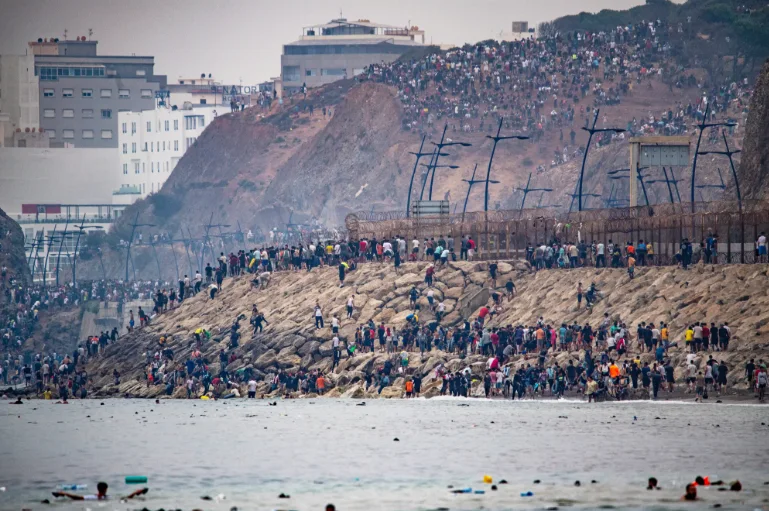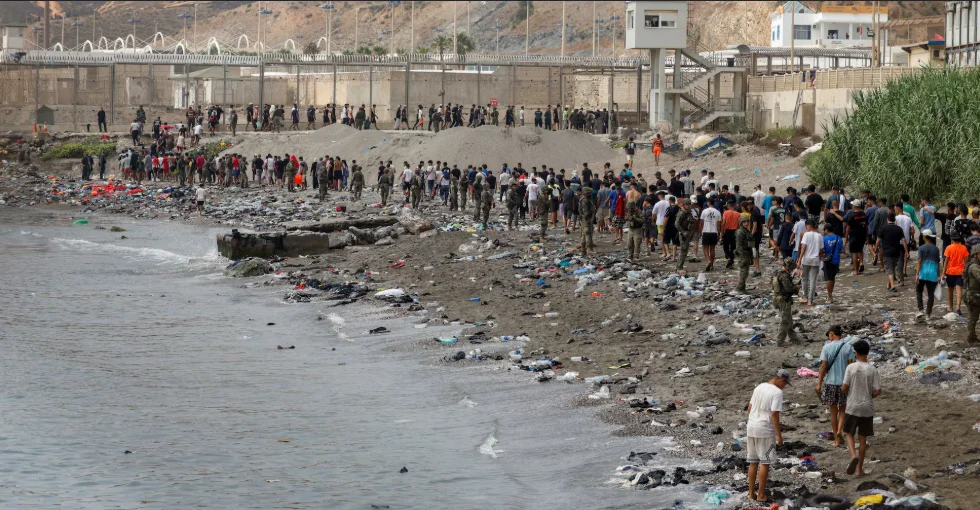
Spain and Morocco have dramatically strengthened security around the Spanish enclave of Ceuta on Saturday, 15 August 2026, as authorities attempt to prevent another large-scale migration crisis at one of the European Union's most politically sensitive borders.
Moroccan authorities arrested at least 111 migrants attempting to reach Ceuta, according to Reuters, after social-media messages encouraged people to participate in another mass crossing. Most of those detained were reported to be from sub-Saharan Africa.
The security operation has turned the area surrounding the Morocco-Spain border into a heavily controlled zone, with police deployed on both sides.
Morocco moves against attempted crossings
Moroccan security forces intercepted groups attempting to approach the border from areas around Fnideq, the Moroccan city neighbouring Ceuta.
Police used tear gas to disperse some groups gathered on hills several kilometres from the frontier, while hundreds of officers—including riot police—were deployed in the surrounding area.
The operation follows online campaigns encouraging people to attempt another mass entry into Spanish territory on 15 August.
Authorities have been particularly concerned because similar social-media mobilization contributed to the extraordinary migration surge that struck Ceuta at the end of July.
Spain reinforces its side of the border
Spain has also substantially increased its security presence.
The number of National Police and Civil Guard personnel in Ceuta has risen from roughly 1,100 to around 1,600, while military personnel are supporting security operations.
A new maritime barrier has also been installed around the El Tarajal area to make unauthorized crossings by sea more difficult.
The measures show how dramatically Madrid's response has changed following the previous crisis.
July's catastrophe hangs over today's operation
The extraordinary security measures cannot be understood without the events of late July.
More than 70,000 people surged toward Ceuta during the earlier crisis, overwhelming border infrastructure and creating chaotic scenes around the Spanish territory.
At least 94 people were confirmed dead in that episode, according to Reuters' latest reporting, while others may remain missing.
That tragedy transformed migration into an even more urgent political issue for Spain and intensified debate across Europe about border security.
Authorities are determined to prevent today's attempted mobilization from producing another catastrophe.
Spain adopts a tougher message
Spanish officials have also hardened their public language.
Interior Minister Fernando Grande-Marlaska warned people considering irregular crossings that they should not believe criminal networks or misleading online messages suggesting they will be able to remain in Ceuta or travel onward to mainland Spain.
That message is politically important.
Spain has historically attempted to balance border enforcement with a relatively humanitarian approach to migration. But the scale of the July crisis has placed the government under intense pressure to demonstrate that it retains control of Europe's southern frontier.
Migration becomes a wider European political challenge
Although Ceuta lies on the North African coast, it is Spanish territory and therefore part of the European Union.
That makes the border one of the EU's direct land frontiers with Africa.
A migration crisis there consequently becomes more than a Spanish domestic problem.
Large-scale arrivals can influence European debates over asylum rules, border controls and cooperation with North African governments.
They can also reshape electoral politics.
Migration has already become one of the most divisive political issues across Europe, strengthening parties demanding tougher border enforcement in several countries.
Spain's handling of the earlier crisis faces scrutiny
Today's operation is also unfolding amid serious questions about whether Spanish authorities responded quickly enough before July's disaster.
Border workers told Reuters that they had repeatedly warned Spain's central government about increasing arrivals and the possibility of escalation before tens of thousands of people attempted to reach Ceuta.
They said the government took insufficient action despite those warnings. Spain's Interior Ministry maintains that it evaluated available measures and subsequently strengthened border infrastructure.
Those allegations could increase political pressure on Madrid as authorities investigate what went wrong.
Why this matters
The fresh development on 15 August 2026 is that the feared second mass crossing has triggered a major security response, with at least 111 people arrested today and Spanish and Moroccan forces maintaining reinforced border operations.
So far, the scale of the security deployment appears to have prevented a repeat of July's enormous influx.
But the political consequences are only beginning.
Spain must now manage thousands of migrants already in Ceuta, investigate the failures surrounding the earlier crisis and determine how its future border policy should work.
For Europe, the events highlight an uncomfortable reality: migration pressure at a small Spanish territory in North Africa can rapidly become a major test of EU border policy, relations with Morocco and the continent's increasingly polarized politics over immigration.