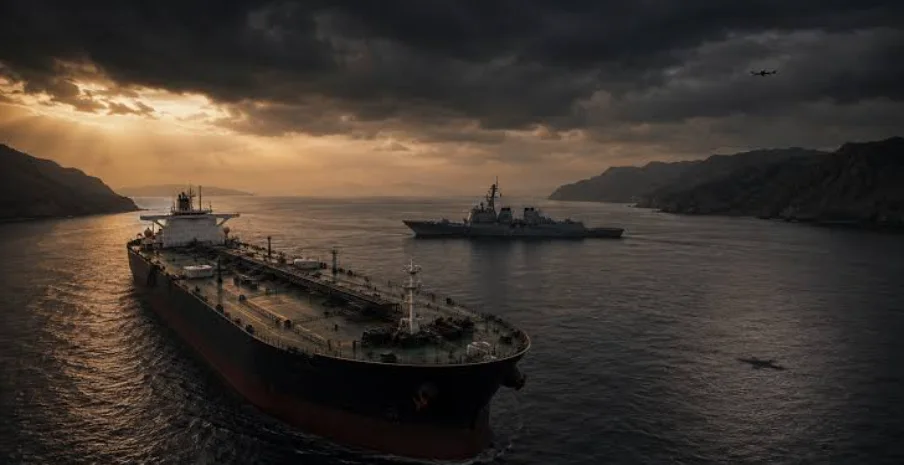
One of the world's most strategically important waterways entered another dangerous phase on 14 August 2026, after two additional commercial ships were attacked and maritime traffic through the Strait of Hormuz slowed dramatically.
The latest incidents add to months of confrontation around the narrow passage connecting the Persian Gulf with the Gulf of Oman and the wider Arabian Sea. Reuters reported Friday that vessel movements appeared to be grinding toward a near halt as ship operators confronted growing security risks.
The consequences could reach far beyond the Middle East.
A critical global shipping route under pressure
The Strait of Hormuz is one of the world's most important energy corridors. Oil and liquefied natural gas produced by several major Gulf exporters normally pass through the waterway before reaching international markets.
That means a serious disruption can quickly become an international economic problem.
Shipping companies must weigh whether sending vessels through the area remains safe. Insurers can increase premiums as risks rise, while traders may begin pricing potential supply disruptions into global energy markets.
The U.S. Maritime Administration currently maintains an active advisory covering the Persian Gulf, Strait of Hormuz and Gulf of Oman, specifically warning about Iranian attacks on commercial vessels.
Two more ships attacked
The fresh attacks reported on August 14 intensified an already dangerous situation.
They came after previous incidents targeting commercial vessels in the region. U.S. Central Command said in July that American forces had conducted strikes against Iranian military targets following attacks on commercial shipping.
The continuing cycle of attacks and military responses has transformed ordinary commercial voyages through the region into increasingly high-risk operations.
For merchant crews, this is not an abstract geopolitical confrontation. Sailors aboard tankers and cargo ships can find themselves operating inside an active security crisis while transporting goods intended for civilian markets around the world.
Washington threatens additional pressure
The United States responded to the latest developments by warning that it could intensify economic pressure on Iran.
That adds another dimension to the confrontation.
The crisis is therefore developing simultaneously across military, diplomatic, economic and commercial fronts, increasing uncertainty about what happens next.
Any further escalation could potentially discourage even more commercial vessels from attempting the passage.
Global energy markets face renewed uncertainty
The biggest international concern is what prolonged disruption could mean for energy supplies.
A temporary slowdown can cause logistical difficulties. A sustained interruption could become considerably more serious.
Oil markets are globally interconnected. Even countries that do not directly import crude through Hormuz can be affected if reduced supply pushes international prices higher.
Higher oil prices can eventually increase transportation, aviation, manufacturing and agricultural costs, feeding through to consumer prices.
Liquefied natural gas shipments are another concern, particularly for countries dependent on imported energy.
Shipping companies confront difficult decisions
Commercial operators now face a calculation involving safety, cost and contractual obligations.
Continuing through a dangerous region could expose crews and expensive vessels to attack. Avoiding the area, however, can delay shipments and create additional costs.
Unlike some other maritime chokepoints, Hormuz is exceptionally difficult to bypass for Gulf producers whose export infrastructure is heavily connected to the Persian Gulf.
That geographical reality is one reason instability there attracts immediate global attention.
Why this is major breaking news
The significance of the 14 August attacks lies not simply in two additional vessels being targeted.
It is the cumulative effect.
Repeated attacks can eventually change the behaviour of an entire shipping industry. When vessel operators conclude that a route has become too dangerous, disruption can spread rapidly from the waterway into commodity markets, supply chains and national economies.
Previous U.S. military statements show how seriously Washington has already treated attacks on shipping in the strait. CENTCOM said in July that U.S. forces had struck hundreds of targets during earlier operations aimed at degrading Iran's ability to attack commercial vessels.