What happened
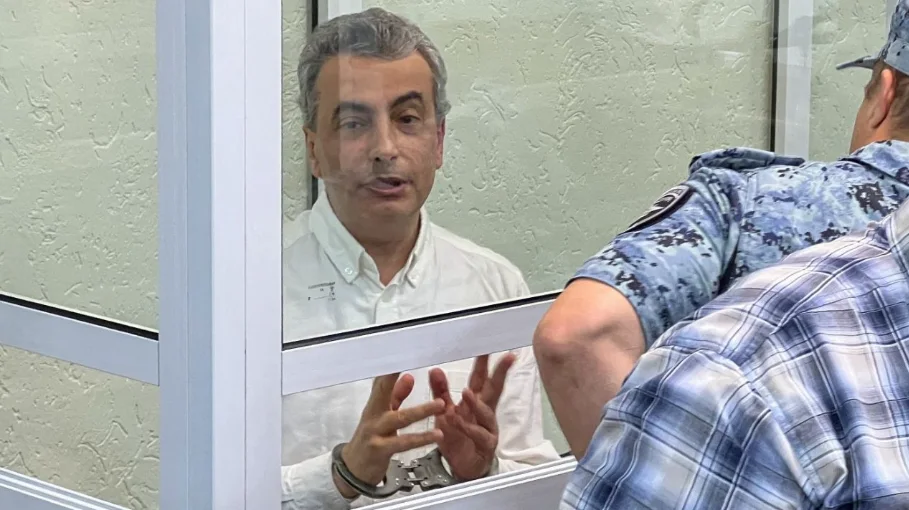
A court in Pskov, Russia, sentenced Lev Shlosberg, deputy chairman of the liberal Yabloko party, to 11 years and one month in a penal colony on Monday, 17 August 2026.
Shlosberg was convicted under Russian laws covering repeated “discrediting” of the armed forces and dissemination of what authorities classify as false information about the military.
According to Yabloko, the charges included Shlosberg's participation in a debate in which he argued for an urgent ceasefire, as well as a social-media repost from 2022. Prosecutors had sought a sentence of 12 years and one month.
Shlosberg, 63, has remained in Russia despite the risks faced by politicians openly opposing the war in Ukraine. During his trial, he described the war as a catastrophe for the country and continued calling for an end to the fighting.
But the prison sentence was only one major political blow to Yabloko today.
Russia's Supreme Court separately rejected the party's appeal against an earlier decision removing it from the ballot for the country's upcoming parliamentary elections. Yabloko is the only officially registered Russian political party that has openly opposed the war in Ukraine.
Together, the two decisions mean one of Russia's most prominent remaining anti-war politicians faces more than a decade in prison while his party is blocked from competing in the forthcoming national election.
Why this matters
The timing is politically significant.
Russia is preparing for parliamentary elections in September 2026, but voters who want an explicitly anti-war alternative will now have far fewer options.
Yabloko had already faced pressure before today's developments. On 10 August, Russia's Supreme Court removed the party's federal list from the State Duma election following a challenge brought by the nationalist Rodina party. Yabloko appealed that decision, but the Supreme Court rejected the challenge today.
The consequences extend beyond one political party.
Since Russia's full-scale invasion of Ukraine in 2022, authorities have adopted and enforced laws restricting public statements about the military that contradict official accounts.
Political activists, journalists and ordinary citizens have faced prosecution under those provisions.
Shlosberg's sentence demonstrates just how severe the consequences can now become for politicians who continue criticizing the war while remaining inside Russia.
Amnesty International condemned today's verdict, arguing that Shlosberg was being punished for exercising freedom of expression through his anti-war debate and social-media activity.
Who is affected
Russian opposition voters are immediately affected.
Removing Yabloko from the parliamentary ballot means voters who oppose the war lose the country's only officially registered party openly campaigning from that position.
Yabloko politicians and activists face an increasingly difficult environment.
Shlosberg isn't the only member to encounter criminal prosecution or restrictions. The party has reported other cases involving members facing detention or being prevented from participating in elections.
Russian civil society and independent political voices are also affected because the case establishes another powerful warning about the potential consequences of publicly challenging official narratives about the war.
The September election itself is affected as well.
The exclusion of a registered opposition party raises further questions about the breadth of political competition available to Russian voters.
BoonVerse Analysis
The most important part of today's story is not either court ruling considered separately.
It is that both happened on the same day.
One ruling removes an anti-war party from the electoral battlefield.
The other removes one of its most prominent politicians from public life for potentially more than a decade.
That combination carries greater political significance than either decision alone.
Russia has already seen many prominent government critics imprisoned, exiled or otherwise removed from domestic political competition.
Yabloko nevertheless occupied an unusual position.
Unlike many opposition movements operating primarily from abroad, it remained a legally registered political party inside Russia and continued attempting to participate through formal political institutions.
That distinction mattered.
A political movement operating online from another country can criticize the government, but it cannot easily provide Russian voters with an option on an actual parliamentary ballot.
Yabloko attempted to do precisely that.
Today's developments significantly weaken that remaining institutional route.
There is another important factor: Shlosberg chose to remain in Russia.
That made his political activity particularly symbolic. While numerous Russian opposition figures have left the country amid legal pressure, Shlosberg continued publicly advocating a ceasefire from within Russia.
His sentence sends a message not only to established politicians but potentially to anyone considering whether anti-war political participation remains possible inside the country's formal political system.
What happens next
Yabloko has indicated that it will continue pursuing legal avenues following the decisions against the party and its members.
But the immediate political calendar is unforgiving.
Russia's parliamentary election is approaching in September, leaving little time for Yabloko to reverse its exclusion and restore its candidates to the ballot.
Shlosberg's legal team and supporters are also expected to challenge his conviction.
Meanwhile, attention will turn toward whether further pressure is applied to Yabloko's leadership, candidates and activists as the election approaches.
The wider question concerns what Russia's parliamentary campaign will look like without an officially registered party openly advocating an end to the war.
Today's events suggest that the political boundaries surrounding that debate are becoming narrower.
For Russia's remaining domestic opposition, 17 August 2026 may therefore be remembered not simply as the day one politician received an 11-year sentence, but as a day when two of the remaining avenues for organized anti-war politics an outspoken leader and a place on the national ballot were simultaneously pushed aside.
Sources
Yabloko's own statements document the prosecution's case against Shlosberg, including the anti-war debate cited in the proceedings, and the party's appeal concerning its removal from the election.
Reuters independently confirmed today's 11-year-and-one-month sentence, Shlosberg's position in Yabloko and his anti-war stance.
Radio Free Europe/Radio Liberty reported today that Russia's Supreme Court rejected Yabloko's appeal, leaving the country's only officially registered openly anti-war party off the September parliamentary ballot. Amnesty International separately condemned Shlosberg's imprisonment on freedom-of-expression grounds.