What happened
Ukraine’s Cabinet of Ministers announced on Monday, 17 August 2026, that it had formally approved the Government’s new Action Program and submitted the document to the Verkhovna Rada, Ukraine’s parliament, within the timeframe required by law.
Prime Minister Sergii Koretskyi described the program as the framework that will determine how his government operates and what it must deliver.
According to the government, the document establishes its working principles, major objectives and specific tasks. Crucially, Koretskyi said responsibility will be clearly assigned across individual areas of government.
The announcement therefore goes beyond a collection of political promises.
It establishes a political scorecard against which ministers and government departments can potentially be judged.
Koretskyi also thanked members of parliament who participated in preparing and finalising the program, signalling that the government has already been working with lawmakers ahead of its formal consideration. He said he hopes parliament will consider the document quickly.
But one objective sits above everything else.
The prime minister said the government's central goal is to endure and win Ukraine’s war for independence.
That places national defence and survival at the heart of the government's broader domestic agenda.
Why this matters
Governments normally publish programs to explain what they intend to accomplish across the economy, public services, infrastructure and state institutions.
Ukraine is operating under radically different circumstances.
Every major government decision is being made while the country continues dealing with the consequences of war.
That means defence cannot easily be separated from economic policy.
Economic growth helps generate tax revenue.
Tax revenue helps finance government services and national defence.
Energy security determines whether homes, hospitals and businesses can continue operating.
Infrastructure investment is tied to reconstruction.
Anti-corruption reforms influence international confidence and Ukraine's relationship with the European Union.
And European integration increasingly requires changes throughout the Ukrainian state.
The government's published priority areas demonstrate the scale of that challenge. They include national security and defence, economic recovery, EU integration, anti-corruption, macrofinancial reforms, healthcare, education, energy security and winter stability.
The new Action Program therefore represents something larger than an administrative document.
It attempts to connect fighting a war, running a country, reforming institutions and preparing Ukraine's European future at the same time.
Who is affected
Ukrainian citizens are the most directly affected.
Government priorities ultimately influence public services, employment, social protection, infrastructure, education, healthcare and economic conditions.
Ukraine's military and defence sector also have enormous stakes in the program because the prime minister has explicitly placed winning the war at the centre of the government's mission.
Businesses and investors will be watching the government's approach to economic recovery, SMEs, investment and reforms.
For businesses operating during wartime, predictable government policy can be particularly important when making decisions about hiring, production and long-term investment.
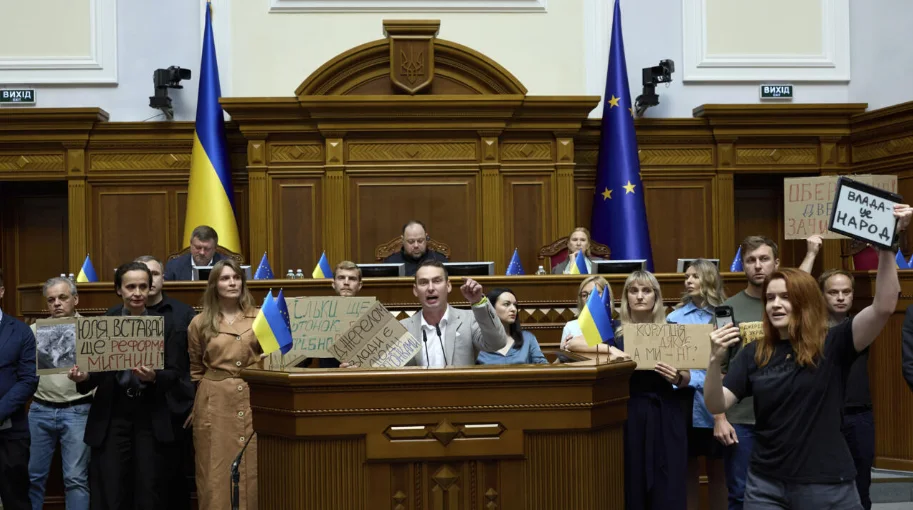
The Verkhovna Rada now becomes central to the process.
The program has moved from the executive branch to parliament, meaning lawmakers will scrutinise the government's priorities and determine their political response.
Ukraine's international partners are affected as well.
European governments and international institutions provide Ukraine with substantial military, financial and humanitarian support.
They therefore have a strong interest in whether Kyiv continues reforms, strengthens institutions and meets commitments connected with international assistance and European integration.
BoonVerse Analysis
The most important phrase in today's announcement may be:
“clear personal responsibility.”
Governments frequently publish ambitious programs.
The difficult part comes later.
Who is responsible when a target is missed?
Which minister owns the failure?
How is progress measured?
What happens when deadlines pass?
By emphasising individual responsibility across policy areas, Ukraine's government is effectively creating expectations that ministers should be judged by results rather than simply by announcements.
That could become especially important during wartime.
Ukraine is simultaneously trying to accomplish several enormous objectives:
Defend the country.
Keep the economy functioning.
Repair damaged infrastructure.
Maintain international financial support.
Fight corruption.
Reform state institutions.
Move closer to European Union membership.
Few governments would find that combination easy under peaceful conditions.
Ukraine must attempt all of them while fighting a major war.
There is another important political dimension.
Submitting the program to parliament transforms government priorities into a test of political coordination.
A government can announce policies on its own.
Implementing major reforms usually requires legislation, budgets and parliamentary support.
That means the relationship between the Cabinet and the Verkhovna Rada could become one of the biggest factors determining whether the program succeeds.
The program also creates something valuable for the public:
a benchmark.
Once a government clearly states what it intends to accomplish, citizens, parliamentarians and international partners can compare promises with actual results.
That accountability could become as important as the program itself.
What happens next
The immediate next step is parliamentary consideration.
The Cabinet has officially submitted the Action Program to the Verkhovna Rada, and Prime Minister Koretskyi has expressed hope that lawmakers will consider it quickly.
Attention will therefore shift from the Cabinet to parliament.
Lawmakers will have an opportunity to examine the government's objectives, question its priorities and assess whether the proposed agenda provides a credible path through Ukraine's wartime challenges.
Implementation will then become the bigger test.
Ukraine's government already identifies a broad set of priorities ranging from defence and economic recovery to European integration, anti-corruption, healthcare, education and energy security.
Delivering progress across all those areas will require money, political coordination and continued international support.
Another development worth watching will be whether the government's promise of clearly assigned responsibility produces measurable public targets.
If individual ministries receive concrete objectives and deadlines, Ukrainians will have a much clearer way of evaluating government performance.
Ultimately, the success of the Action Program will not be determined by its approval on 17 August 2026.
It will be determined by what happens afterward.
For Ukraine, that means converting a government document into results while confronting one of the most difficult challenges any European state currently faces:
reforming and rebuilding the country while simultaneously fighting to defend it.
Sources
Cabinet of Ministers of Ukraine 17 August 2026: The official government announcement confirms approval of the Action Program, its submission to the Verkhovna Rada, the government's emphasis on specific tasks and personal responsibility, and Prime Minister Sergii Koretskyi's statement about the program's overriding wartime objective.
Cabinet of Ministers of Ukraine Government approves Action Program and submits it to Parliament
Government of Ukraine Government Priorities: The official government portal identifies areas including national security and defence, economic recovery, EU integration, anti-corruption, macrofinancial reforms, healthcare, education and winter stability among the government's priorities.