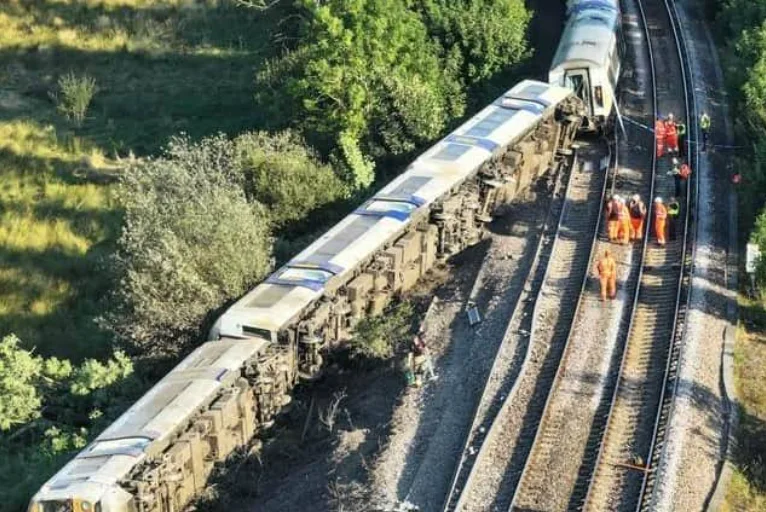
A routine rail journey in southeast England turned into a major emergency after a passenger train derailed near Lewes in East Sussex, leaving overturned carriages and dozens of passengers requiring medical attention.
The accident occurred on 14 August 2026, with approximately 150 people aboard the train when at least three carriages came off the tracks and overturned near Lewes railway station.
Emergency services descended on the area as passengers were helped from the damaged train and medical teams assessed those who had been hurt.
Authorities reported that 20 people suffered injuries. Two were seriously injured, while 18 sustained injuries described as less serious.
Carriages leave the tracks
The scale of the derailment immediately raised concern because several carriages were involved rather than a minor mechanical incident affecting a single section of the train.
Images from the scene showed emergency personnel working around the derailed train as investigators began examining the railway.
For passengers, the sudden transition from an ordinary journey to an overturned railway carriage would have happened within moments.
Although the accident caused serious injuries, the absence of reported fatalities prevented the incident from becoming an even greater tragedy.
Rail investigators move in
Determining why the train derailed is now one of the most important questions.
A rail accident can result from numerous factors, including track problems, equipment failures, environmental conditions or combinations of several circumstances. The cause should not be assumed until investigators complete their examination.
Reports on 14 August indicated that concerns had previously been raised about deteriorating or unusually “bumpy” track conditions in the area, adding another issue investigators may need to examine.
That does not establish that track conditions caused the derailment, but it makes the investigation particularly important.
A second derailment deepens concern
The incident became even more striking when another passenger train derailed near Wickford in Essex on 14 August, less than 24 hours after the East Sussex accident.
In the second incident, rear carriages of a Greater Anglia passenger train left the rails but remained upright. No injuries were reported, although the accident caused substantial disruption and line closures between London Liverpool Street and Southend Victoria.
The occurrence of two derailments within such a short period does not by itself mean the accidents were connected.
However, their timing is likely to intensify public attention on rail infrastructure and safety.
Passengers face major disruption
Beyond the injuries, derailments can have widespread consequences for railway operations.
Damaged or obstructed tracks may have to remain closed while investigators document the scene, recovery crews remove carriages and engineers determine whether infrastructure is safe for trains to begin running again.
That can affect thousands of passengers well beyond those aboard the train involved in the accident.
The priority, however, remains establishing what happened and ensuring that any safety problem identified during the investigation is addressed before another serious incident occurs.
Why this is major breaking news
Rail travel moves enormous numbers of people every day, which means a passenger train leaving the tracks particularly with carriages overturning immediately becomes a significant public-safety event.
The Lewes accident left 20 people injured, two of them seriously, despite approximately 150 passengers being aboard.
And the second derailment near Wickford later added an unsettling dimension to the story.
Investigators now face two crucial tasks: establishing exactly what caused the Lewes derailment and determining whether anything about the railway infrastructure or operating conditions requires urgent action.
For passengers across Britain, the events of 14 August 2026 have put an uncomfortable question back into focus: how could two passenger trains derail within such a short period, and what must be done to prevent it happening again?