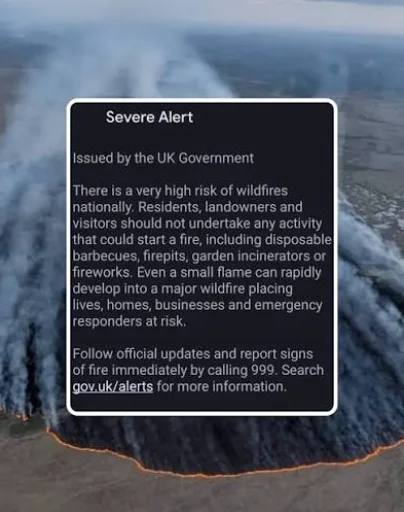
Millions of mobile phones across England and Wales sounded an emergency warning on Friday as the British government took the extraordinary step of using its national alert system amid a serious wildfire threat.
The 14 August 2026 Emergency Alert warned people about the heightened danger and urged the public to take precautions as authorities battled fires during exceptionally dry and dangerous conditions.
The development marks a significant escalation in the government's response.
Authorities announced a package that includes military assistance, additional funding and restrictions aimed at preventing human activity from triggering more fires. The government said the wildfire risk remained very high across England and Wales.
In Wales, the emergency has become serious enough for military personnel to join the operation.
The Welsh Government confirmed that incidents were being managed through an established multi-agency emergency structure, bringing together organisations involved in firefighting, public safety and emergency coordination.
Around 100 military personnel have been deployed to assist with the major incident in South Wales as wildfires continue to burn in parts of the country.
The nationwide phone warning is particularly notable because emergency-alert systems are normally reserved for situations in which authorities believe rapid communication could help protect large numbers of people.
Rather than depending solely on television, radio or social media, the technology allows an urgent warning to appear directly on compatible mobile phones within the targeted area.
For communities close to active fires, the situation can change rapidly. Strong winds can push flames into new areas, while smoke can create additional hazards even for people who are some distance from the fire itself.
The government's decision therefore sends a clear message: the wildfire threat is being treated as a national public-safety emergency rather than simply a series of isolated countryside fires.
The crisis also highlights how extreme heat and prolonged dry conditions can place enormous pressure on emergency services. Vegetation that would normally contain more moisture can become highly combustible, allowing relatively small fires to spread quickly.
Beyond the immediate danger to homes and communities, large wildfires can damage farmland, wildlife habitats, transport infrastructure and local businesses while requiring substantial resources to bring under control.
Authorities are now urging people to avoid behaviour that could accidentally ignite additional fires and to follow instructions from emergency services.
The coming hours will be critical. Fire crews, government agencies and military personnel will be watching weather conditions closely while attempting to contain existing outbreaks and prevent new ones.
For Britain, the emergency alert issued on 14 August 2026 represents one of the clearest indications yet of the seriousness of the current wildfire situation and of the scale of the response authorities believe is necessary to protect communities.