India has unveiled a sweeping new national development framework aimed at shaping the country's economic, technological and strategic direction over the next two decades.
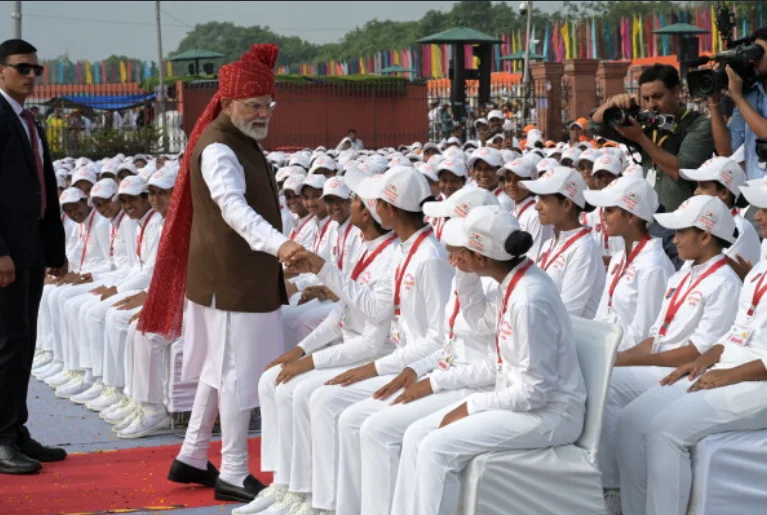
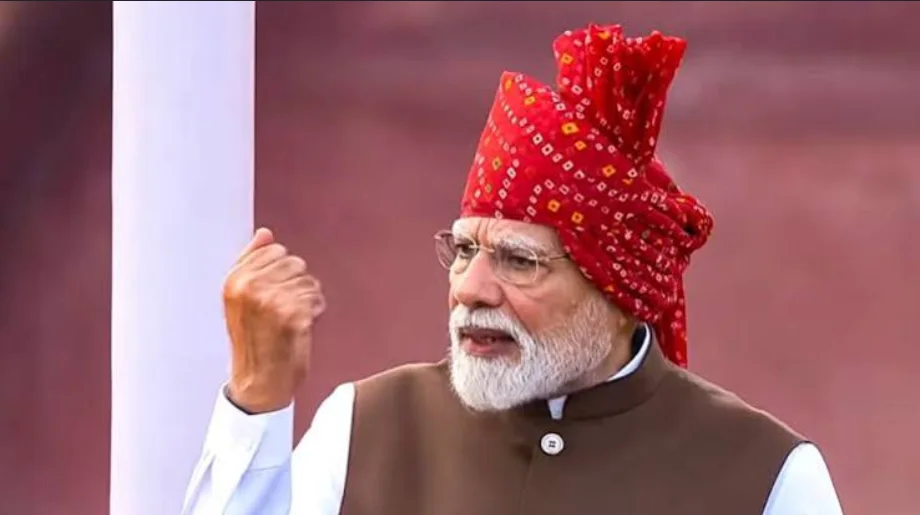
Speaking from New Delhi's historic Red Fort during India's 80th Independence Day celebrations on 15 August 2026, Prime Minister Narendra Modi announced “Sapta Dhara,” or seven streams of strength, as a central framework for India's ambition to become a developed nation by 2047.
The announcement brings together seven major priorities: manufacturing, agriculture and food processing, technology and innovation, infrastructure, defence, the green and blue economy, and India's soft power.
Seven priorities for India's next phase
Rather than focusing on a single government programme, Sapta Dhara attempts to connect several areas of national policy under one long-term strategy.
Manufacturing is one of the central pillars.
India has spent years attempting to increase domestic production and attract international manufacturers seeking alternatives or additions to existing Asian supply chains. Expanding manufacturing could create employment while reducing dependence on imported products and components.
Agriculture and food processing form another pillar, reflecting the enormous role rural communities continue to play in India's economy.
Increasing food-processing capacity could allow more agricultural products to be converted into higher-value goods before reaching domestic and international markets.
Technology moves closer to the centre of government policy
Technology and innovation feature prominently in the new framework.
Modi also announced a separate initiative to provide AI skills training to 10 million young people over the coming year, underscoring the government's intention to prepare India's workforce for a rapidly changing technological economy.
That is significant because India already possesses one of the world's largest pools of software and technology professionals.
Artificial intelligence is now changing the skills companies require. Training millions of additional people could strengthen India's position as businesses worldwide expand investment in AI development and deployment.
Infrastructure remains essential
The framework also places infrastructure at the centre of national development.
India's enormous population and rapidly growing cities require continued investment in roads, railways, airports, logistics networks, energy systems and digital infrastructure.
Better transportation networks can reduce the cost of moving products between factories, farms, ports and consumers.
Infrastructure development therefore connects directly with the manufacturing and agricultural ambitions contained elsewhere in the strategy.
Defence becomes an economic priority
Defence capability is another of the seven pillars.
India has increasingly sought to manufacture more military equipment domestically rather than depending heavily on imports.
That has both security and economic implications.
A larger domestic defence industry can potentially create advanced manufacturing jobs, develop engineering capabilities and strengthen local supply chains while reducing dependence on overseas suppliers.
The inclusion of defence within Sapta Dhara demonstrates that New Delhi increasingly views national security and industrial development as interconnected.
Green and blue economies enter the strategy
Environmental industries also received a prominent position.
The green economy encompasses areas such as renewable energy, cleaner manufacturing and technologies designed to reduce environmental impact.
The blue economy, meanwhile, focuses on economic opportunities connected to oceans and coastal resources.
India's extensive coastline gives maritime industries considerable potential, ranging from ports and shipping to fisheries and offshore energy.
Balancing those opportunities with environmental protection will be an important challenge.
India's influence abroad is also part of the plan
Perhaps the most unusual pillar is soft power.
Unlike manufacturing or infrastructure, soft power concerns a country's ability to influence the world through culture, diplomacy, education, technology and international relationships rather than military force alone.
India already possesses considerable global cultural reach through cinema, cuisine, its diaspora and increasingly its digital and technological industries.
Making soft power an explicit part of a national development framework signals that the government views international influence as an important component of India's rise.
Why this matters
The announcement made on 15 August 2026 is politically significant because it provides a broad framework through which Modi's government can organize policy around its long-standing ambition of achieving a “Viksit Bharat,” or developed India, by 2047.
The challenge will be implementation.
Transforming seven broad ambitions into measurable improvements in employment, productivity, infrastructure, technology and living standards will require enormous investment and coordination over many years.
But the political message from the Red Fort today was clear: India wants its next stage of development to combine economic expansion with technological leadership, stronger defence capabilities, environmental industries and greater international influence.
With a population exceeding one billion and an increasingly important role in global economics and geopolitics, the success or failure of that strategy could have consequences extending far beyond India's borders.