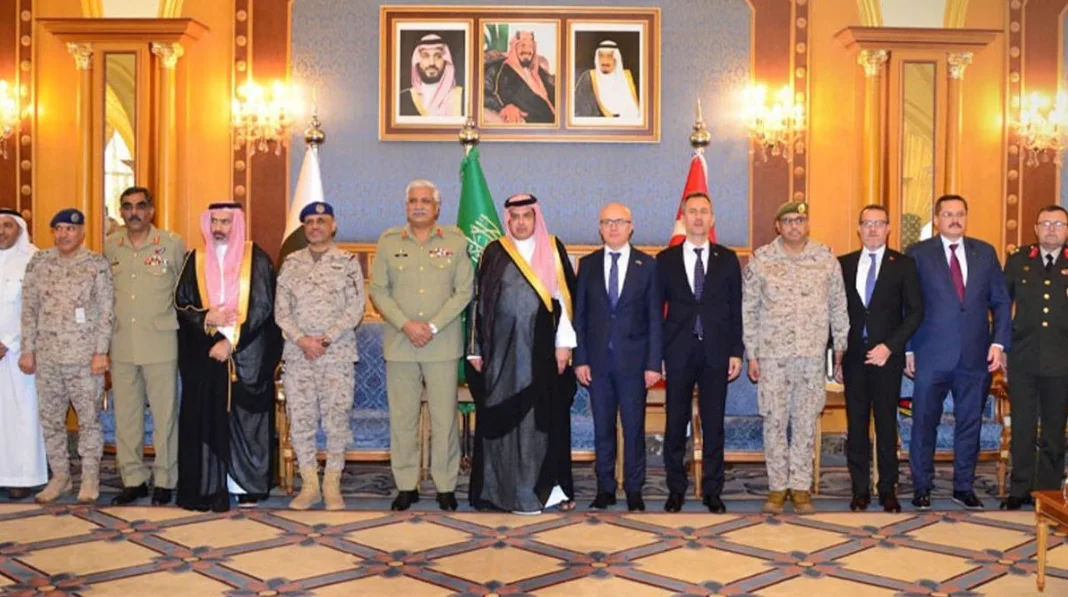
The security landscape of the Middle East shifted dramatically on Friday as three influential Muslim-majority countries formed a new mutual-defence partnership in the holy city of Mecca.
Saudi Crown Prince Mohammed bin Salman, Turkish President Recep Tayyip Erdoğan and Pakistani Prime Minister Shehbaz Sharif signed the Mecca Joint Defence Agreement, committing their countries to respond collectively if any member is attacked.
Its central principle is both simple and far-reaching: aggression against Saudi Arabia, Türkiye or Pakistan will be regarded as aggression against the entire partnership.
The agreement brings together three countries with significantly different strengths. Saudi Arabia possesses enormous financial and energy influence, Türkiye operates one of the region’s most capable conventional militaries, and Pakistan is a nuclear-armed state with extensive defence experience.
Despite Pakistan’s nuclear status, the published information does not say that its nuclear deterrent will automatically cover the other signatories. Officials described the agreement as a defensive arrangement intended to discourage attacks, rather than a plan directed against a particular country.
The timing is nevertheless impossible to separate from the instability surrounding the three nations. Missile and drone attacks, threats to Gulf energy routes and growing doubts about traditional foreign-security guarantees have encouraged regional governments to strengthen their own military partnerships.
For Saudi Arabia, the agreement adds another layer of protection for its cities, oil infrastructure and shipping interests. Türkiye gains closer strategic access to two important Asian partners, while Pakistan strengthens its longstanding military and economic relationships with both countries.
The pact could lead to expanded intelligence sharing, coordinated military planning, joint exercises, defence-industrial projects and cooperation against terrorism. However, its complete text has not been publicly released, leaving important questions about automatic troop deployments and command arrangements unanswered.
The agreement may also complicate Türkiye’s position inside NATO. Ankara already falls under NATO’s collective defence system, but neither Saudi Arabia nor Pakistan belongs to the alliance. Future crises could therefore test how Türkiye balances its commitments to the two separate security structures.
Iran, Israel, India, the United States and Gulf governments will closely examine the new partnership. Any regional confrontation involving one signatory could now carry the risk of drawing in two additional military powers.
Supporters may view the pact as a stabilising shield capable of discouraging aggression. Critics may fear that it could divide the region into competing blocs, making a future crisis larger and more difficult to contain.
What began as a signing ceremony in Mecca could therefore become one of the defining geopolitical developments of 2026—a new security triangle with the military, economic and diplomatic power to reshape relations across the Middle East and South Asia.