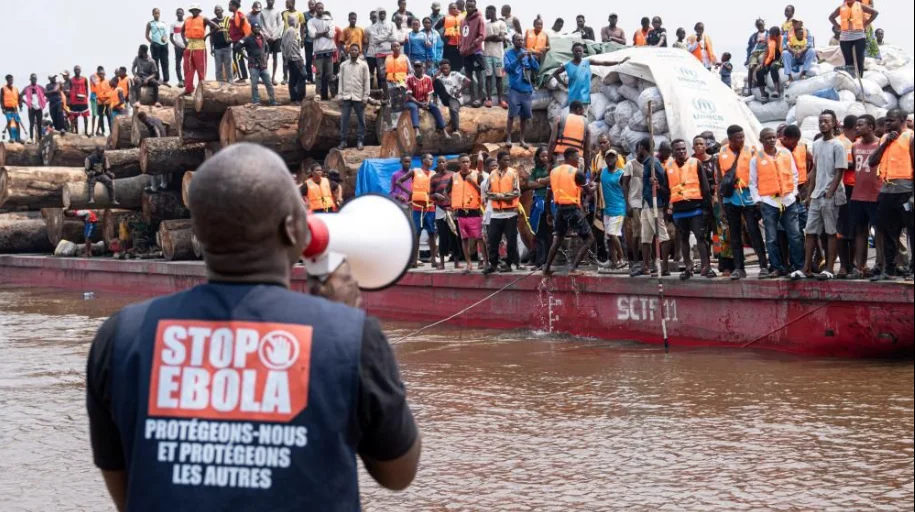
A passenger boat carrying more than 300 people has become the centre of an emergency disease-control operation near Kinshasa, one of Africa’s largest cities.
Congolese authorities intercepted the vessel at Maluku, approximately 65 kilometres upstream from the capital. Medical teams were deployed to determine whether passengers had been exposed to Ebola during their journey.
Every person on board was undergoing temperature checks and clinical screening on Thursday. Health workers were looking for fever and other symptoms that could indicate infection or require further investigation.
Four passengers displaying possible symptoms had medical samples collected and sent for laboratory analysis. Their results were expected on Friday, meaning it remained too early to conclude that Ebola had spread aboard the vessel.
The alarm was raised after officials connected the boat to a 32-year-old man who died on 25 July after developing symptoms considered consistent with Ebola. His infection had not yet been conclusively confirmed in the information released about the operation.
Authorities have provided differing accounts of the man’s journey. Some information suggested that he became ill while travelling, while another account indicated that his symptoms began only after he left the boat.
There is also uncertainty about where he boarded. Documents found with him reportedly connected him to Kisangani in Tshopo province, where an outbreak has been active, but officials said the boat may instead have travelled from Mongala province, where no Ebola cases had been recorded.
These unanswered questions make contact tracing particularly difficult. Investigators must reconstruct the passenger’s movements, identify everyone who may have interacted with him and determine whether he had any connection to an affected area.
A mobile laboratory was taken to the intercepted vessel so that the response could begin without moving hundreds of potentially exposed passengers into Kinshasa. Preventing unnecessary travel is a critical precaution when dealing with a suspected infectious disease.
Ebola can spread through direct contact with the blood or bodily fluids of an infected person, as well as contaminated materials. It does not spread as easily as airborne illnesses, and the presence of one suspected traveller does not mean every passenger has been infected.
Health authorities are also considering wider use of a vaccine developed for the Zaire Ebola species after evidence suggested it could offer some protection against the Bundibugyo species involved in the current outbreak. Expanded use of the antiviral medicine remdesivir is also being planned in affected areas.
The situation remains under investigation. At the time of publication, more than 300 people were being screened, four symptomatic passengers were awaiting results, and no confirmed transmission aboard the boat had been announced.