Taiwan has conducted a dramatic rehearsal of how its president and senior government officials would be protected if the island came under military attack.
President Lai Ching-te put on body armour and a helmet before entering an armoured personnel carrier for a late-night journey to a secure command centre.
The operation formed part of the Han Kuang military exercises, Taiwan’s largest annual war games. The 2026 programme is scheduled to continue for 10 days and includes both military operations and civilian emergency preparations.
This was Lai’s first participation as president in the emergency relocation plan known as “Wan Chun,” a name associated with carrying an enormous responsibility or weight.
The plan dates back to the Cold War and is designed to protect Taiwan’s leadership during war or another national crisis. Its central goal is to ensure that the government can continue issuing orders even if ordinary offices and communication systems are attacked.
During the exercise, Lai and senior officials practised commanding defensive operations from the protected facility. Agencies also tested their ability to coordinate decisions while working away from their normal locations.
Taiwan has long considered the possibility that an invading force could attempt a “decapitation strike”—an attack intended to kill or capture the president and senior leaders before the military can organise a response.
The exercise therefore focused on more than protecting one person. Moving the president safely is intended to preserve constitutional authority, military command and public communication during the opening hours of a conflict.
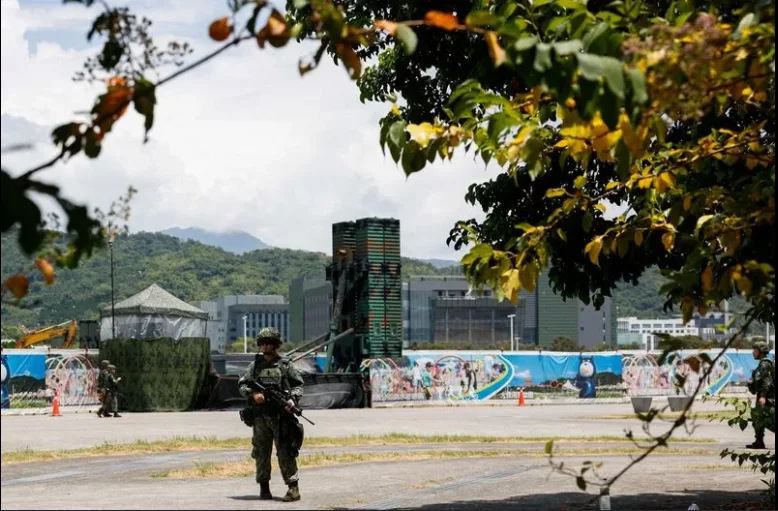
Elsewhere on the island, Patriot and domestically produced Tien-Kung III air-defence systems were deployed in urban areas. Coastguard vessels also practised carrying missile launchers that could be installed during wartime.
Taiwan plans another unusual test next week: deliberately slowing mobile-internet speeds. The exercise will examine how government agencies and citizens communicate when networks become congested or damaged.
The military reported detecting 14 Chinese aircraft and nine warships around Taiwan on Wednesday. Chinese forces operate near the island regularly, although Beijing had not publicly responded to the latest Taiwanese exercises.
China considers Taiwan part of its territory and has not ruled out using force to bring it under Beijing’s control. Taiwan’s government rejects China’s sovereignty claim and maintains that the island’s people must decide their own future.
The sight of a president in protective equipment entering an armoured vehicle illustrates how seriously Taiwan is preparing for a possible conflict. However, no invasion or real emergency had been declared; the movement was entirely part of a planned exercise.