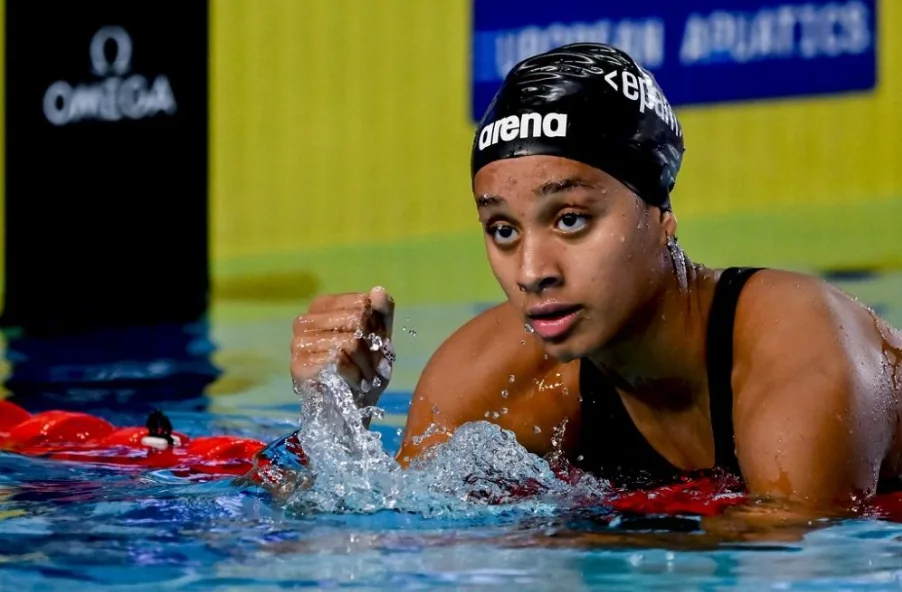
12 August 2026 — Paris, France: Sara Curtis arrived at the European Aquatics Championships hoping to win her first major senior individual title. She left Wednesday’s semifinal as the fastest woman in history over 50 metres backstroke.
The 19-year-old Italian stunned the Olympic Aquatic Centre in Paris by touching the wall in 26.63 seconds, demolishing the world record previously held by Australia’s Kaylee McKeown.
McKeown’s record of 26.86 had stood since October 2023. Curtis removed 0.23 seconds from it—an enormous improvement in an event decided by the smallest fractions of a second.
For several moments after looking at the scoreboard, the Italian appeared unable to process what she had achieved. The semifinal had not merely qualified her for another race; it had rewritten swimming history.
A Record Before the Final
Curtis produced the landmark performance during the semifinals rather than the medal race.
That creates an unusual situation: she is already a world-record holder but must return to the pool and complete the final if she wants to become European champion.
The Italian entered the competition as the European record holder after swimming 27.07 seconds in Rome in June. Her Paris performance lowered her personal best by an extraordinary 0.44 seconds.
European Aquatics confirmed Curtis’s world record in its official report from the third day of competition.
Alina Gaifutdinova recorded the second-fastest semifinal time at 26.91 seconds. That performance was also among the fastest ever achieved, demonstrating how high the standard may be when the finalists return to the starting blocks.
Curtis will enter that race as the clear favourite, although swimming history contains many examples showing that semifinal speed does not guarantee a medal.
More Than a Backstroke Specialist
Curtis’s performance becomes even more impressive when considering the variety of events she contests.
She had already claimed bronze in the 100-metre freestyle at the Paris championships and contributed to Italy’s silver medal in the women’s 4x100-metre freestyle relay.
Combining elite freestyle and backstroke speed makes her an important asset for Italy in both individual competitions and relays.
Curtis currently studies and trains at the University of Virginia in the United States, an institution that has developed several internationally successful swimmers. Her progress reflects the increasingly global nature of elite sport: an Italian athlete, training in America, breaking an Australian swimmer’s record at a championship in France.
The End of McKeown’s Complete Collection
Kaylee McKeown once held the women’s world records in all three backstroke distances—50, 100 and 200 metres.
Curtis’s swim removes the 50-metre record from that collection and signals the arrival of a new challenger in international women’s backstroke.
McKeown remains one of the most accomplished swimmers of her generation, but records exist to be attacked. Curtis did not improve the mark cautiously; she pushed it into entirely new territory.
The verified competition report confirms that Curtis became the first swimmer to set a world record during the Paris championships.
A New Name at the Centre of World Swimming
World records can sometimes arrive at the end of a carefully planned campaign. Curtis produced hers while still chasing a place in the final.
That may be the most exciting part of the story. At 19, she is not presenting this performance as the conclusion of a decorated career. It could be the opening chapter.
The final will determine who receives the European gold medal. Nothing that happens there, however, can erase what Curtis accomplished in the semifinal.
For 26.63 seconds in Paris, the Italian teenager did not simply race against seven other swimmers. She raced against every woman who had ever competed in the event and finished ahead of them all.