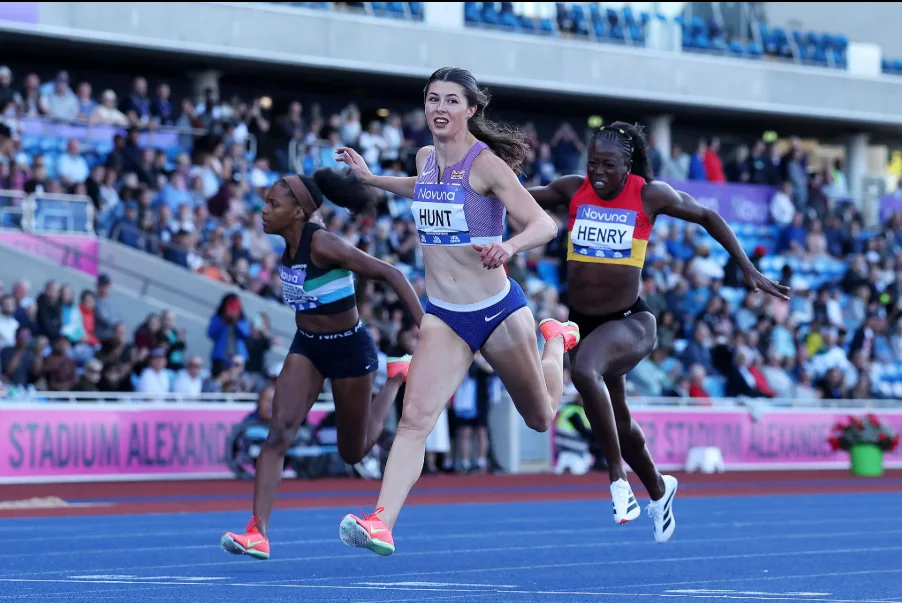
For half a lap around Birmingham’s Alexander Stadium, Amy Hunt carried the expectations of a home crowd and never allowed them to slow her down.
The British sprinter powered through the bend, entered the home straight with a narrow advantage and resisted a rapidly closing Rhasidat Adeleke to win the European women’s 200-metre title in 22.19 seconds.
Adeleke produced an Irish national record of 22.28 seconds to claim silver. Britain’s Dina Asher-Smith, Hunt’s training partner and one of the continent’s most decorated sprinters, finished only one-hundredth of a second behind the Irish runner to secure bronze in 22.29.
The margins were tiny, but Hunt’s control was unmistakable.
Instead of exploding too aggressively from the blocks, she built her speed progressively around the curve. By the time the finalists entered the straight, Hunt had created enough separation to withstand Adeleke’s powerful late challenge.
Crossing the line brought more than a single victory. Hunt had already won the 100 metres in 11.00 seconds on the championships’ opening night. Her triumph on 13 August completed the prestigious European sprint double and placed her alongside the select athletes capable of dominating both short-distance disciplines at the same major competition.
The official European Athletics report described the 22.19-second performance as the fastest by a European woman during the 2026 season.
Hunt’s rise has not followed a perfectly straight track. Earlier in her career, she gained attention as a teenage record-breaker before balancing athletics with her university studies. Her transition into senior competition required patience as she adapted to stronger opponents, greater expectations and the physical strain of international racing.
That patience is now producing results.
At 24, Hunt appears to be entering the most important stage of her career with a combination of raw speed and improved competitive judgement. She no longer races simply to produce a fast time; she is learning how to position herself, conserve energy through championship rounds and deliver her strongest performance when medals are decided.
Her victory also carried symbolic importance for British athletics. Asher-Smith has led the country’s women’s sprinting generation for years, collecting global and European medals while inspiring younger athletes. Seeing Hunt defeat her experienced training partner did not necessarily represent the end of one era, but it offered convincing evidence that Britain’s next leading sprinter has arrived.
Adeleke’s silver added another layer to the final. Her 22.28-second national record demonstrated that Irish sprinting is progressing rapidly, while the closeness of the podium suggested that future European contests between Hunt, Adeleke and Asher-Smith could become some of athletics’ most compelling rivalries.
The 200-metre gold may not be Hunt’s final medal of the championships. Britain is also competing in the women’s and mixed 4×100-metre relays, giving her an opportunity to leave Birmingham with as many as four gold medals.
Achieving that would require successful baton exchanges, strong performances from her teammates and the ability to recover after two demanding individual competitions. However, Hunt’s form has made the possibility appear far more realistic than it did when the championships began.
The World Athletics competition report confirmed Hunt’s sprint double as one of the defining performances of the championship’s fourth day.
For the Birmingham crowd, the race lasted only 22.19 seconds. Its significance will endure much longer. Amy Hunt arrived at the championships as one of Britain’s leading medal hopes; she left the 200-metre final carrying a more powerful title Europe’s fastest woman over both sprint distances.