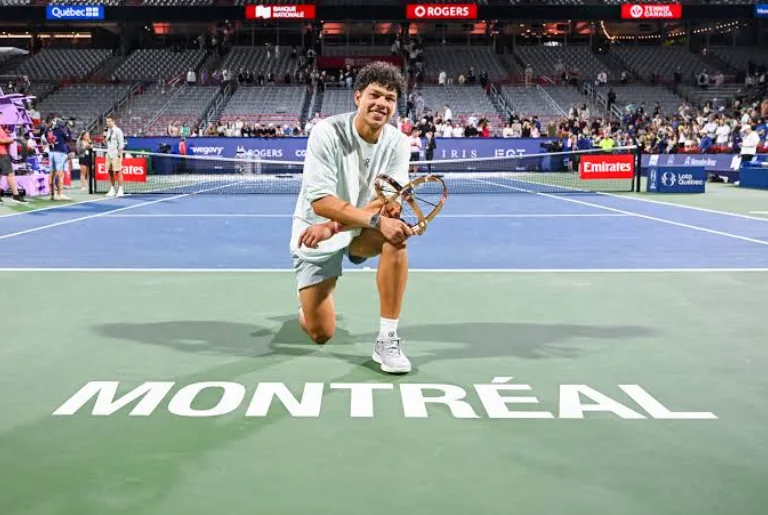
The final point left Ben Shelton’s racket like a message delivered at full speed.
As his forehand flew beyond Brandon Nakashima’s reach, Shelton turned towards his team, pointed at the court and released a triumphant roar. Montreal had witnessed more than another tournament victory—it had seen one of men’s tennis’s most explosive young players transform a title defence into a statement of authority.
Shelton defeated Nakashima 6–3, 7–6(4) in the Canadian Open final on 13 August, securing his second Masters 1000 championship and the seventh singles title of his professional career.
The fifth seed completed six matches without losing a set. Throughout the tournament, his powerful left-handed serve gave opponents few opportunities, while his improved returning and movement allowed him to control rallies that once might have escaped him.
In the final, Shelton created the first decisive opening at 3–3 in the opening set. A fierce return produced the breakthrough, and he quickly converted the advantage into control of the match. Nakashima attempted to slow the pace and extend the rallies, but Shelton continued attacking with his forehand and refused to give his opponent a break point.
The second set was tighter. Nakashima protected his serve and forced a tiebreak, hoping that a handful of points could change the direction of the contest. Shelton remained composed, finding the angles he needed before sealing victory after one hour and 27 minutes.
According to the official ATP match report, Shelton converted two of his four break opportunities and did not face a single break point. The victory also improved his record against Nakashima to six wins from six meetings.
The result carries historical weight. Shelton became only the fourth man this century to defend the Canadian Masters title successfully, following Andy Murray, Novak Djokovic and Rafael Nadal. Entering a list containing three former world number ones places the achievement far beyond an ordinary tour victory.
It was also a significant evening for American men’s tennis. Shelton and Nakashima contested the first all-American Masters 1000 final since Andy Roddick defeated Mardy Fish in Cincinnati in 2003. For a country that has spent years searching for another consistent men’s Grand Slam contender, the final offered encouraging evidence that a new generation is becoming competitive at the sport’s highest levels.
Shelton’s success in Montreal was his fourth title of 2026. He had already won in Dallas, Munich and Stuttgart, demonstrating that his game can survive on different surfaces and in different competitive conditions.
What made the Canadian performance especially impressive was its discipline. Shelton is widely recognised for his speed, athleticism and thunderous serve, but raw energy alone did not win this championship. He selected his attacks carefully, protected his service games and remained patient whenever opponents attempted to disrupt his rhythm.
The timing could hardly be better. With the US Open approaching, Shelton will arrive in New York carrying both confidence and expectation. His powerful game naturally attracts attention on American hard courts, but Montreal showed that he is becoming more than an exciting performer. He is learning how to control tournaments from beginning to end.
The trophy may have been presented in Canada, but its warning travelled across the tennis world: Ben Shelton is no longer simply chasing the established stars. He is beginning to create territory of his own.