Nigeria is preparing for a major shift in how food is produced, with the federal government placing machinery, technology and private investment at the centre of its strategy to transform agriculture.
The Federal Ministry of Agriculture and Food Security has unveiled the National Agricultural Mechanization Policy alongside a dedicated investment strategy intended to move agricultural mechanization from isolated equipment programmes toward a coordinated national system.
One of the most significant parts of the plan is the government's intention to establish a large tractor assembly plant in Nigeria with annual capacity of between 2,000 and 4,000 tractors.
Building tractors domestically could reduce Nigeria's dependence on imported agricultural machinery while supporting local manufacturing, technical skills development, maintenance services and employment.
But the government's strategy goes beyond simply putting more tractors on farms.
Agriculture and Food Security Minister Senator Abubakar Kyari described mechanization as an ecosystem extending from land preparation and planting to irrigation, harvesting, processing, storage, transportation, precision agriculture and digital technologies.
The government wants to develop what amounts to a mechanization-as-a-service economy, where farmers who cannot afford to purchase expensive equipment can obtain machinery services when they need them.
That approach could be particularly important for smallholder farmers. Owning a tractor may be financially impossible for many individual producers, but access to affordable mechanized services could still allow them to cultivate larger areas, complete farm operations faster and reduce dependence on manual labour.
The scale of the programme is already substantial.
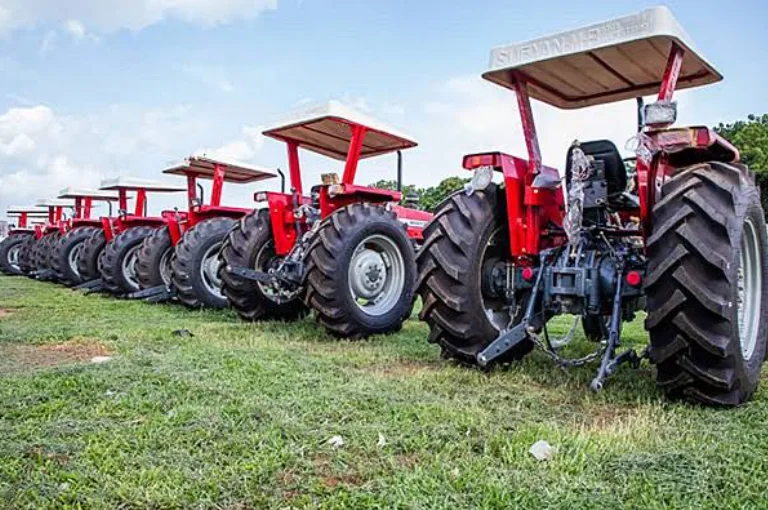
Under the Renewed Hope National Agricultural Mechanization Programme, the federal government says it has started procuring and deploying 2,000 tractors together with more than 9,000 assorted implements and spare parts.
The policy also divides responsibilities across several sectors. The federal government is expected to coordinate standards and national policy, while state governments support implementation, infrastructure and access to land. Private companies are expected to invest and provide services, while financial institutions develop financing and risk-sharing mechanisms.
Research organisations and development partners will provide additional technical expertise.
The government is also attempting to position agricultural mechanization as an economic opportunity for young people and women rather than treating farming primarily as subsistence activity.
That could create opportunities far beyond operating tractors. A larger mechanized farming industry would require technicians, machinery operators, software developers, equipment-leasing businesses, spare-parts suppliers, irrigation specialists, logistics providers and agricultural technology companies.
Why this matters
Nigeria is Africa's most populous country, meaning improvements in its agricultural productivity can have consequences beyond its borders.
Greater domestic food production could reduce pressure from food imports, strengthen rural economies and potentially improve the resilience of regional food supplies.
However, purchasing thousands of machines alone will not guarantee success.
The bigger test will be whether tractors and other equipment remain operational, affordable and accessible to ordinary farmers. Maintenance networks, spare parts, financing, trained operators and transparent distribution will therefore be just as important as the number of machines purchased.
Nigeria's new strategy reflects a wider transformation taking place across agriculture: the future farm is increasingly becoming a combination of land, machinery, financing, data and technology.
If the programme moves successfully from policy into implementation, Nigeria could create one of Africa's largest agricultural mechanization ecosystems potentially changing how millions of farmers plant, harvest and bring food to market.