An unexpected discovery in a South African pasture could eventually give farmers a powerful new defence against one of Africa’s most destructive crop pests.
During an African armyworm outbreak in 2025, entomologist Letodi Luki Mathulwe began receiving urgent reports from farmers in KwaZulu-Natal. Large numbers of caterpillars were entering fields, consuming grass and threatening the grazing land required to feed cattle.
But one group of fields presented a mystery.
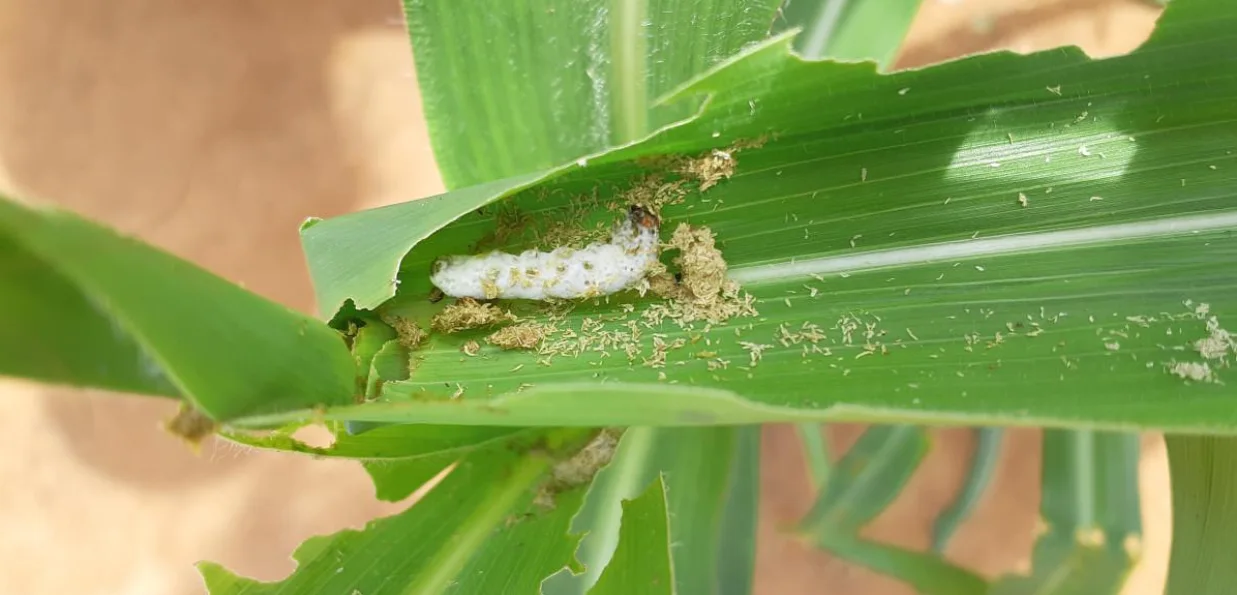
Instead of moving through the grass and feeding, numerous armyworms were lying dead. Their bodies were covered by a white substance that appeared to be spreading naturally through the insect population.
Mathulwe collected affected caterpillars and returned with them to the laboratory. Subsequent investigations identified the killer as Metarhizium rileyi, a naturally occurring fungus known for infecting certain insect species.
The findings were published in the peer-reviewed journal Biocontrol Science and Technology and attracted wider international attention on 12 August 2026.
The discovery matters because mature African armyworms can be difficult to control. Chemical pesticides may work when infestations are identified early, but farmers often notice the insects only after they have grown larger, gathered in dense groups and begun causing visible destruction.
By that stage, the caterpillars may already be moving rapidly across fields.
The African armyworm—scientifically named Spodoptera exempta—primarily attacks grasses and cereal crops. Its preferred foods include maize, sorghum, millet, rice and young wheat plants. It can also damage pasture needed by cattle, goats and other livestock.
It should not be confused with the fall armyworm, Spodoptera frugiperda. Both are serious agricultural pests, but they are separate species with different origins and behaviour.
African armyworm outbreaks can appear suddenly after rainfall. Adult moths travel long distances with seasonal winds before laying large numbers of eggs in areas containing fresh vegetation. Once the eggs hatch, the caterpillars may assemble in dense populations and advance together, creating the marching behaviour behind their name.
A field that looks healthy one day can experience substantial damage within a short period.
For smallholder farmers, the consequences extend beyond losing crops. Families may lose both food and income, while livestock farmers face shortages of safe grazing material. Governments can also be forced to purchase and distribute pesticides during widespread outbreaks.
A fungal treatment could provide a different approach.
Metarhizium rileyi acts as an insect pathogen. Its spores attach to a susceptible caterpillar, germinate and penetrate the body. The fungus then develops inside the insect, eventually killing it and producing additional spores that may infect other caterpillars under suitable environmental conditions.
If scientists can transform the fungus into a reliable biological pesticide, farmers could potentially apply it during an outbreak in much the same way that other crop-protection products are sprayed.
Such a product could reduce reliance on broad chemical insecticides, some of which can affect beneficial insects, expose agricultural workers to health risks or leave unwanted residues in the environment.
Biological control may also become increasingly important as pests develop resistance to commonly used chemicals.
However, the discovery is not yet a finished commercial solution. Researchers must determine how effectively the fungus works under different field conditions and against various stages of the armyworm’s development.
Temperature and humidity can significantly influence fungal activity. A treatment that performs well in the laboratory or a humid KwaZulu-Natal pasture may behave differently in the drier farming areas of Malawi, Zambia, Zimbabwe or another affected country.
Scientists will also need to develop a stable formulation that can be stored, transported and applied without destroying the living spores. Production costs, shelf life, application timing and compatibility with other pest-management practices must all be evaluated.
Environmental and regulatory assessments will be necessary to confirm that the proposed treatment does not harm beneficial insects or other non-target organisms.
A related project in Zambia recently achieved the first local harvest of Metarhizium rileyi spores intended for biological control of fall armyworm. Although that project targets a different armyworm species, it demonstrates growing African capacity to research and produce fungus-based crop protection.
The South African finding could become especially valuable as climate instability creates favourable conditions for unpredictable pest outbreaks. Changes in rainfall, temperature and wind patterns can alter where armyworm moths travel and where their eggs successfully hatch.
Early-warning systems will therefore remain essential. Even an effective biological pesticide works best when an infestation is detected before caterpillar numbers become overwhelming.
The discovery also demonstrates the value of observing what is already happening in nature. Mathulwe did not begin with a manufactured chemical or a genetically engineered organism. She noticed that something in the field was successfully controlling a pest and followed the evidence back to the laboratory.
For African farmers, the promise is significant: a crop-protection tool drawn from the soil beneath their own fields.
But the next stage will determine whether that promise can move from scientific research into an affordable product that reaches farmers before the next armyworm invasion begins.