What happened
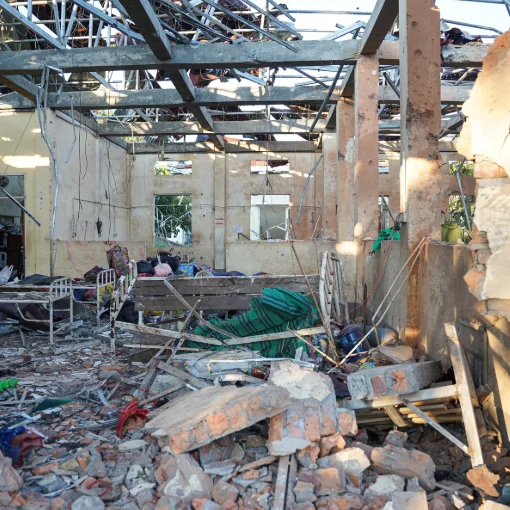
A medical compound in Kinpan village, Pinlebu Township, Sagaing Region, was devastated after a series of airstrikes on Sunday, 16 August 2026, according to reporting from Democratic Voice of Burma based on residents and local resistance sources.
The facility was operated under the administration of Myanmar’s opposition National Unity Government (NUG).
Local reports say the Myanmar Air Force carried out 10 airstrikes against Kinpan village, with the hospital compound directly affected.
At least three civilians were reported killed.
One was a six-year-old child.
Another 15 hospital patients were reported injured.
The attack also destroyed a school building located inside the medical compound, according to residents.
Search teams have been clearing debris from the site, and local sources warned that the number of casualties could increase if additional victims are discovered beneath the wreckage.
Pinlebu lies roughly 305 kilometres north of Monywa, the capital of Sagaing Region.
The town has been under opposition administration following its capture by resistance forces in October 2024, placing it within one of the most contested parts of Myanmar’s continuing civil war.
Myanmar’s military had not provided a public account of this specific attack in the reporting reviewed.
That makes an important distinction necessary: the casualty and operational details remain based primarily on local and opposition-linked accounts rather than independently verified access to the site.
Why this matters
The target makes this attack particularly serious.
This was not simply another battlefield position.
Patients were inside a medical compound.
Hospitals occupy a unique position during armed conflict because civilians and wounded people depend on them precisely when the surrounding environment becomes dangerous.
Destroying medical infrastructure can therefore produce consequences far beyond the casualties caused during the initial attack.
A bomb can destroy a hospital in seconds.
But afterwards:
A pregnant woman may have nowhere nearby to deliver safely.
An injured civilian may have to travel much farther for emergency treatment.
Children may lose access to basic healthcare.
People requiring medication may suddenly find their local medical supply chain broken.
And healthcare workers themselves may flee because they fear another strike.
The latest incident also fits into a wider pattern that international investigators are already examining.
The United Nations-established Independent Investigative Mechanism for Myanmar (IIMM) reported this month that aerial attacks affecting civilians have escalated, including evidence of “double-tap” attacks in which subsequent strikes appear to hit rescuers and people responding to an initial attack.
Who is affected
Patients at Kinpan Hospital face the most immediate consequences.
Fifteen were reported injured in the attack, while the destruction of parts of the compound could disrupt treatment for many more people who were not physically wounded.
Children have also been caught directly in the violence.
The reported death of a six-year-old transforms the casualty statistics into something much harder to ignore.
A child who should have been protected from war instead became one of its victims.
Healthcare workers face another dilemma.
They must continue treating patients while knowing that the building in which they work may itself become dangerous.
Residents across Pinlebu Township could also lose access to medical services if the facility cannot resume operations quickly.
And the broader population of Sagaing remains exposed to a conflict that has repeatedly brought air attacks into civilian areas.
BoonVerse Analysis
There is something especially disturbing about attacking a place where people go because they are already vulnerable.
A hospital is where someone runs after the bomb falls.
What happens when the hospital itself is bombed?
That question captures one of the most dangerous dimensions of Myanmar’s conflict.
Modern warfare is not measured only by territory captured.
It is also measured by what remains functional after fighting moves through a community.
A town can technically remain standing while losing the institutions that make ordinary life possible.
Hospital.
School.
Market.
Electricity.
Water.
Road.
Communications.
Destroy enough of those systems and civilians may eventually leave even if nobody formally orders them to evacuate.
That creates displacement without necessarily requiring troops to physically remove residents.
The situation becomes even more serious when air power is involved.
Ground fighting normally gives people some indication that danger is approaching.
Aircraft can arrive much faster.
The UN investigative mechanism reported this month that Myanmar’s military has increasingly used not only conventional aircraft but also drones, gyrocopters and motorized paragliders carrying unguided explosives.
Some alleged attacks have involved aircraft approaching quietly, reducing the warning available to civilians.
That changes the psychology of everyday life.
People begin listening to the sky.
Parents wonder whether children should attend school.
Patients wonder whether hospitals are safe.
Rescuers may hesitate after an explosion because another strike could follow.
The UN mechanism says it is collecting evidence that could potentially support future prosecutions for international crimes. It has gathered material from more than 1,600 sources and witnesses concerning alleged violations committed during Myanmar’s conflict.
That means today's destruction could eventually become evidence.
Photographs.
Witness accounts.
Aircraft information.
Bomb fragments.
Coordinates.
Medical records.
Each can contribute to reconstructing exactly what happened.
But accountability moves slowly.
For civilians in Sagaing, the immediate question is much simpler:
Where do you take an injured person when the place designed to save them has itself been destroyed?
What happens next
The first priority is determining the full casualty toll.
Local rescue teams have been searching through the damaged compound, particularly around the destroyed school building, and initial reports warned that additional victims could potentially be found.
Medical care for the 15 reported wounded patients is another immediate challenge.
If parts of Kinpan Hospital are no longer usable, patients may need to be transferred elsewhere—something that can become extremely difficult in an active conflict zone.
Attention will also turn toward independent verification of the attack.
Myanmar’s war has fragmented information networks, while journalists and international investigators cannot freely reach many contested locations. Casualty figures therefore sometimes change as witnesses, hospitals and local authorities provide additional information.
The international dimension will also continue.
The UN’s investigative mechanism has already warned that Myanmar’s escalating aerial warfare is producing evidence of potential serious international crimes.
Its investigators are preserving information for possible future legal proceedings.
For Pinlebu, however, international accountability remains distant.
The immediate reality is rubble.
A hospital compound has been hit.
Patients have been wounded.
At least three civilians are reported dead.
One was only six years old.
And as rescuers continue searching through what remains, Myanmar’s war has produced another question the outside world cannot easily dismiss:
If hospitals are no longer safe, where exactly are civilians supposed to hide?
Sources
Democratic Voice of Burma — 17 August 2026: The primary detailed report says residents and resistance sources reported 10 airstrikes on Kinpan village, killing at least three civilians, including a six-year-old child, and injuring 15 hospital patients. It also reports continuing searches through the damaged compound.
DVB — Airstrikes target hospital in Pinlebu Township
Associated Press / UN Independent Investigative Mechanism for Myanmar — 11 August 2026: Provides broader independent context documenting an escalation in aerial attacks affecting civilians, including allegations of double-tap strikes and the growing use of drones, gyrocopters and motorized paragliders.