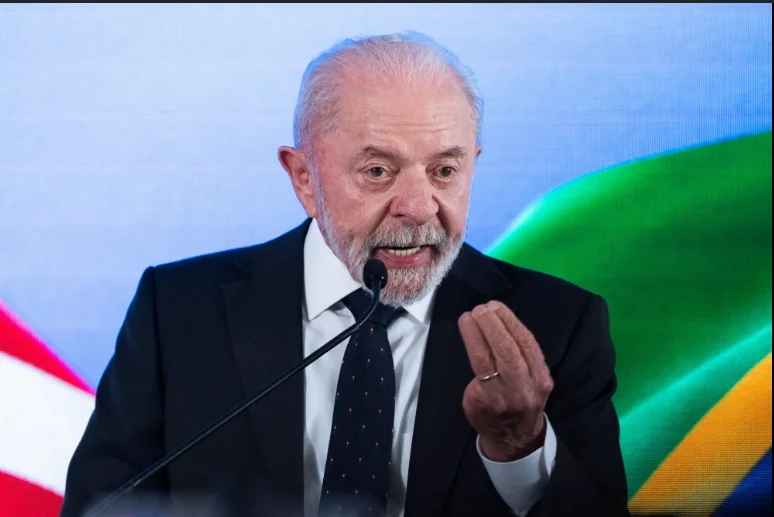
Brazilian President Luiz Inácio Lula da Silva continues to lead the country’s presidential election race, but Senator Flávio Bolsonaro has gained ground as campaigning intensifies ahead of the October 2026 vote.
A Quaest survey commissioned by Brazilian brokerage Genial found that Lula would receive 44% of the vote in a hypothetical second-round contest, compared with 39% for Bolsonaro. Lula’s five-point advantage is smaller than the eight-point lead recorded in the previous Quaest survey published on 15 July, when he led by 45% to 37%.
The movement suggests that Brazil’s election could become increasingly competitive. However, the survey is only a snapshot of voter opinion and does not predict the final result.
In a simulated first round, Lula received 39% support, while Bolsonaro secured 30%. Other candidates remained far behind, with Renan Santos and Ronaldo Caiado each receiving 4%, followed by Romeu Zema at 2%.
The previous poll placed Lula at 40% and Bolsonaro at 28% in the first round. These results indicate that Lula’s support remained broadly stable while Bolsonaro gained approximately two percentage points.
Under Brazil’s electoral system, a presidential candidate must obtain more than 50% of valid votes to win in the first round. If no candidate reaches that threshold, the two leading contenders advance to a runoff.
The Quaest survey interviewed 2,004 people between 31 July and 3 August. It has a margin of error of two percentage points, meaning the candidates’ actual support could be slightly higher or lower than the published figures.
Lula, who is 80, recently received his Workers’ Party’s nomination to seek a fourth nonconsecutive presidential term. He previously governed Brazil between 2003 and 2010 before returning to office in January 2023.
His principal challenger, Flávio Bolsonaro, is a senator and the eldest son of former President Jair Bolsonaro. The elder Bolsonaro remains a highly influential figure within Brazil’s conservative movement despite being under house arrest for plotting a coup following his defeat in the 2022 election.
The campaign is expected to focus heavily on the economy, household living costs, crime, corruption, environmental protection and Brazil’s international relationships. Both leading candidates represent sharply different political directions.
Lula supports stronger social programmes, protection of the Amazon rainforest and closer engagement with developing countries through organizations such as BRICS. His government has also promoted stronger cooperation among Latin American states.
Flávio Bolsonaro is expected to appeal to conservative voters by emphasizing security, traditional values, market-friendly economic policies and closer ties with right-wing governments, particularly the administration of US President Donald Trump.
The election is also unfolding amid diplomatic tensions between Brazil and the United States. Brazil has accused foreign officials of attempting to influence its electoral process, while Washington has criticized some decisions made by Lula’s government and Brazilian institutions.
The outcome will carry consequences beyond Brazil. The country is a major agricultural exporter, an important producer of critical minerals and energy, and home to most of the Amazon rainforest. Its president also influences relations across Latin America and within the Global South.
With several weeks of campaigning remaining, voter preferences could continue to change. The poll does not show Bolsonaro leading the election; it shows that he has narrowed Lula’s advantage while the incumbent remains ahead.