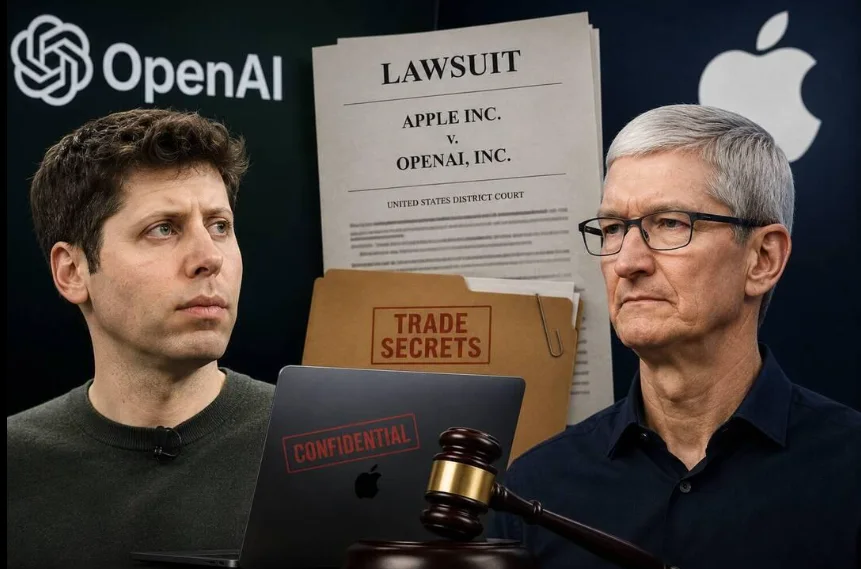
Two companies that currently cooperate to bring ChatGPT to Apple devices are now fighting over who owns the knowledge that could shape the next generation of personal technology.
OpenAI has filed a motion asking a federal judge to dismiss a lawsuit brought by Apple. The dispute centres on allegations that OpenAI and two former Apple employees improperly obtained confidential information connected to Apple’s hardware development.
Apple filed its case in July against OpenAI and former employees Chang Liu and Tang Yew Tan. Tan spent more than two decades at Apple and worked on products including the iPhone and Apple Watch before joining the AI company’s consumer-hardware operation.
The iPhone manufacturer alleges that OpenAI systematically acquired confidential information through former staff members, recruitment interviews and relationships with component suppliers. Apple argues that the information could help its new rival avoid years of independent research and development.
OpenAI has rejected those accusations. In its dismissal request, the company said it neither needs nor wants Apple’s trade secrets and maintained that it is creating something entirely new.
Its lawyers also argued that Apple had not described the alleged secrets clearly enough or provided sufficient facts showing that OpenAI had actually misappropriated them. A court will ultimately decide whether the allegations are detailed enough for the lawsuit to continue.
Neither company has fully revealed the consumer device at the centre of the competition. OpenAI established a hardware division after combining with io Products, a company connected to former Apple design chief Jony Ive.
The involvement of Ive and several former Apple engineers has intensified speculation that OpenAI is developing a new category of AI-first personal device. The company has not confirmed whether that product will resemble a phone, wearable device, smart assistant or something without a conventional screen.
Such a product could change how people interact with artificial intelligence. Instead of opening separate applications and typing instructions, users might communicate continuously with an assistant capable of seeing, hearing and understanding its surroundings.
That possibility creates a strategic threat for established smartphone companies. If AI becomes the main interface between people and digital services, traditional operating systems and app stores could lose some of their control over user attention.
The lawsuit is particularly unusual because Apple and OpenAI remain commercial partners. ChatGPT is integrated with Siri and Apple Intelligence, while iPhone users can access OpenAI services through Apple’s devices.
Their legal confrontation shows that partnerships in the AI industry can exist alongside intense competition. Apple needs access to powerful generative-AI technology, while OpenAI may need expertise in product design, manufacturing and consumer hardware to reduce its dependence on phones and computers made by other companies.
Apple has asked the court for a preliminary injunction that could restrict the defendants from using disputed information while the case proceeds. OpenAI’s motion seeks to end the lawsuit before it reaches the evidence-gathering and trial stages.
At present, Apple’s claims remain allegations, and OpenAI’s request for dismissal has not been decided. A court hearing concerning the dispute is expected later in the year.
Whatever the legal outcome, the conflict offers an important glimpse into technology’s next competitive battlefield. The world’s biggest companies are no longer fighting only over which AI model gives the best answers—they are competing to build the physical device through which people may experience artificial intelligence every day.