Quantum computing remains far from replacing conventional computers, but a growing number of institutions are now willing to purchase the machines and operate them inside their own research facilities.
Rigetti Computing reported second-quarter revenue of approximately $5.14 million, up from about $1.8 million during the same period in 2025. Sales of quantum systems and components were an important contributor to the increase.
The California-based company develops superconducting quantum processors. These devices operate at extremely low temperatures and use quantum bits, known as qubits, to explore certain calculations in ways that differ fundamentally from ordinary computers.
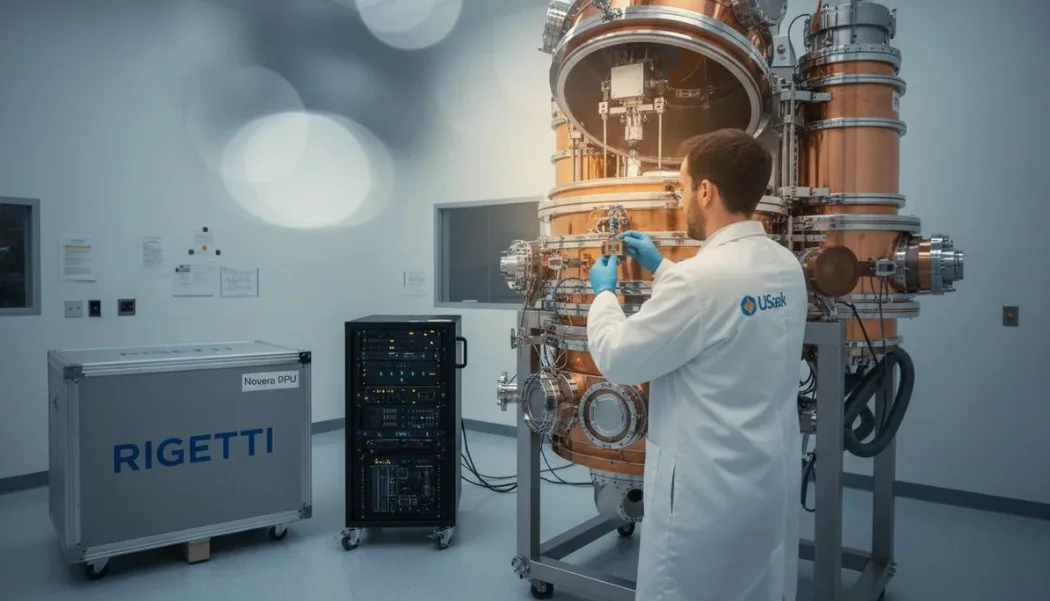
Rigetti has received orders for systems using its Novera quantum processing unit. The Novera is a nine-qubit device intended for researchers developing quantum algorithms, studying error correction and experimenting with combinations of classical and quantum computing.
Unlike users who access a quantum computer remotely through the internet, institutions purchasing a Novera system can install the processor in their own laboratories. This gives researchers greater control over experiments, hardware integration and testing.
The company has also delivered a system to an Indian research centre, expanding the international reach of its quantum hardware. India is investing in quantum research through universities, government programmes and national computing initiatives.
Another Rigetti system is planned for the Pittsburgh Supercomputing Center’s TangleLab. The project, supported through funding from the United States National Science Foundation and developed with Hewlett Packard Enterprise, will combine conventional supercomputing infrastructure with quantum technology.
Hybrid systems are currently viewed as one of the most practical paths for quantum research. A traditional computer performs most of the calculation and management work, while a quantum processor is assigned narrowly defined tasks that may benefit from quantum behaviour.
This approach acknowledges the limitations of current machines. Modern quantum processors remain sensitive to heat, electrical interference and other disturbances that can introduce errors before a calculation is completed.
Rigetti is working to improve the accuracy and scalability of its superconducting processors. The company designs its own chips and operates specialised manufacturing facilities, giving it more direct control over the relationship between hardware design and production.
Despite rising revenue, commercial quantum computing remains financially challenging. Rigetti reported an operating loss of approximately $28.1 million for the quarter, compared with about $20.4 million a year earlier.
Those losses reflect the heavy expense of semiconductor fabrication, cryogenic equipment, research staff and experimental systems. Building reliable quantum machines requires substantial investment long before sales can cover development costs.
Rigetti is also pursuing a possible agreement under which the United States Commerce Department would provide approximately $100 million in funding in exchange for an equity interest. The proposed arrangement had not been finalised at the time of the results.
Government involvement demonstrates the strategic importance countries now place on quantum technology. A sufficiently advanced system could eventually affect drug research, materials science, logistics, financial modelling and cryptography.
However, those possibilities should not be confused with present-day capability. Today’s machines remain experimental, and no company has yet produced a fault-tolerant general-purpose quantum computer capable of consistently solving valuable problems beyond the reach of leading conventional systems.
The significance of Rigetti’s quarterly update lies instead in the gradual creation of a real hardware market. Universities and research centres are beginning to purchase quantum processors, train specialists and build the surrounding infrastructure needed for future development.
Quantum computing is therefore entering an important transitional period. The machines are not yet ready to transform everyday computing, but they are slowly leaving isolated corporate laboratories and entering the hands of a broader scientific community.