The global competition to control artificial-intelligence computing entered another phase on Thursday when AMD revealed plans to acquire Taalas, a Canadian startup attempting to redesign how AI models operate inside chips.
Financial details of the proposed transaction were not disclosed. The agreement must also pass the customary regulatory and closing requirements before Taalas officially becomes part of AMD.
Founded in 2023 and headquartered in Toronto, Taalas concentrates on AI inference—the stage at which a trained model processes new information and produces an answer, prediction, image or recommendation. Every response generated by an AI assistant and every automated decision made by an intelligent application requires inference computing.
This part of the AI industry is becoming increasingly important as companies move beyond experimental models and begin serving millions of users. While training a sophisticated model can consume enormous computing resources, operating that model continuously may eventually create an even larger expense.
Taalas approaches the problem by designing hardware around the requirements of particular AI models. Its technology arranges the movement and processing of data more directly, potentially reducing the delays caused when processors repeatedly transfer information between computing and memory components.
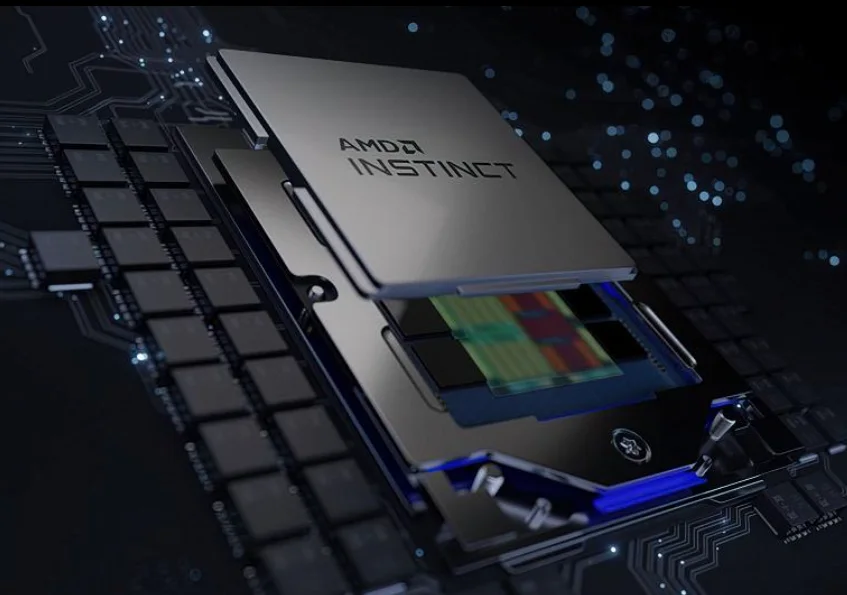
AMD plans to incorporate the startup’s technology into its future accelerator roadmap. It could eventually work alongside AMD Instinct graphics processors, EPYC server CPUs, Helios rack-scale systems and the company’s ROCm software platform.
The acquisition is therefore about more than purchasing another processor design. AMD is assembling the different technologies required to provide complete AI systems—from individual chips and software to entire data-centre installations.
Taalas had raised approximately $219 million from investors before the acquisition announcement, including a $169 million funding round completed in February 2026. Its engineers and specialised intellectual property now give AMD another route for improving inference speed and reducing the electricity needed to operate large AI services.
The deal also increases pressure on Nvidia, which remains the dominant supplier of advanced AI accelerators. Nvidia has similarly expanded beyond general-purpose graphics processors by introducing systems incorporating specialised inference technology. Both companies recognise that customers increasingly want the most economical processor for each stage of an AI workload.
AMD has been expanding its inference capabilities through several transactions. It previously acquired high-speed inference software developer MK1, memory-optimisation company MEXT and added the FastFlowLM team to its artificial-intelligence division.
For cloud providers and businesses deploying AI, stronger competition could eventually bring lower operating costs and a wider selection of hardware. It may also encourage companies to use processors created for particular models instead of depending entirely on expensive general-purpose accelerators.
The most significant question is whether AMD can successfully unite its growing collection of chips, software and newly acquired engineering teams. If the integration works, Taalas could help AMD transform from an alternative GPU supplier into a company capable of providing specialised computing across the entire AI system.