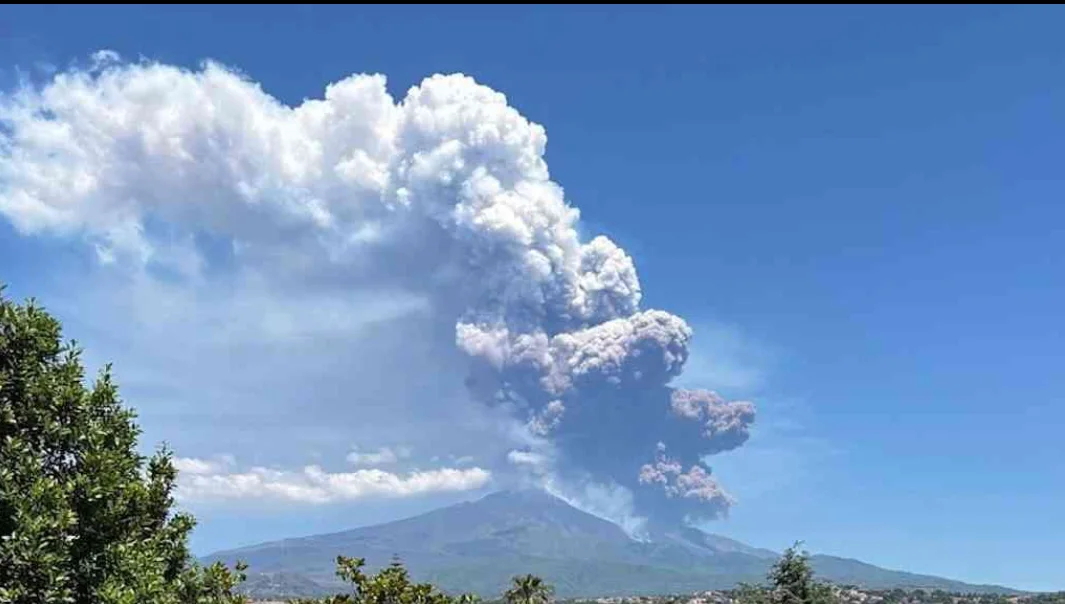
Europe’s largest active volcano roared above Sicily on Saturday, filling the sky with ash and forcing aviation authorities to close part of the airspace surrounding Catania.
Mount Etna’s activity intensified around its Voragine summit crater, producing powerful explosions and fountains of glowing lava. Volcanic material was carried southeast by the wind, with ash reported in communities including Ragalna and Adrano.
The eruption also produced a fresh lava flow after an eruptive opening developed at an altitude of approximately 2,750 metres. Monitoring teams continued observing the volcano as conditions around the summit changed rapidly.
Catania Airport suspended all arriving flights until midday because aircraft could not safely pass through the contaminated airspace. Departures were initially allowed to continue, although passengers were warned to check their flights before travelling to the terminal.
Volcanic ash presents a serious aviation hazard. The fine particles can damage windscreens, interfere with instruments and melt inside jet engines, potentially causing them to lose power. Even when lava poses no immediate threat to populated areas, airborne ash can shut down flight operations many kilometres away.
The disruption struck during the peak European holiday season. Catania serves eastern Sicily and provides access to some of the island’s busiest tourist destinations, meaning temporary restrictions can affect thousands of travellers and create delays across other airports.
Incoming operations resumed after conditions improved, but authorities maintained close surveillance of the volcano. Italy’s Civil Protection Department listed Etna at a yellow alert level, signalling that heightened attention remained necessary even though no immediate large-scale evacuation had been ordered.
Etna has shaped the land and lives of Sicilians for centuries, yet its eruptions remain unpredictable enough to interrupt modern transportation within minutes. Saturday’s spectacle demonstrated that beneath one of Europe’s most visited islands, powerful geological forces are never entirely at rest.