Artificial-intelligence developers have spent billions of dollars acquiring increasingly powerful processors. Lumilens believes the industry’s next major obstacle is no longer simply obtaining enough chips—it is enabling those chips to communicate with one another efficiently.
The San Jose-based company develops photonic interconnects that transmit information using light. These products are designed to connect processors, servers and equipment racks inside enormous AI data centres, where conventional electrical connections are beginning to face physical limitations.
Lumilens announced that it had secured more than $700 million through its latest Series C financing. The investment brings the company’s total funding above $900 million and gives it a valuation of approximately $5.51 billion.
The financing was co-led by Atreides Management, Bain Capital Ventures, Meritech, Seligman Ventures and Spark Capital. Other participating investors included Qualcomm Ventures, Mayfield, Peak XV, HarbourVest and J.P. Morgan Private Capital.
The scale of the investment is remarkable because Lumilens was established only in 2024. Despite its relatively short history, the company says it has already started delivering optical networking products to production AI data centres operated by one of the world’s four largest cloud-computing companies.
Lumilens did not identify the customer, but said the commercial agreement is worth several billion dollars. The leading hyperscale cloud operators are Amazon, Google, Microsoft and Meta, although there is no confirmation of which company signed the contract.
Modern AI facilities may contain tens of thousands of graphics processors working together. Their computing capacity becomes less valuable when information cannot travel between them quickly enough. Copper connections also consume increasing amounts of energy as transmission speeds and distances grow.
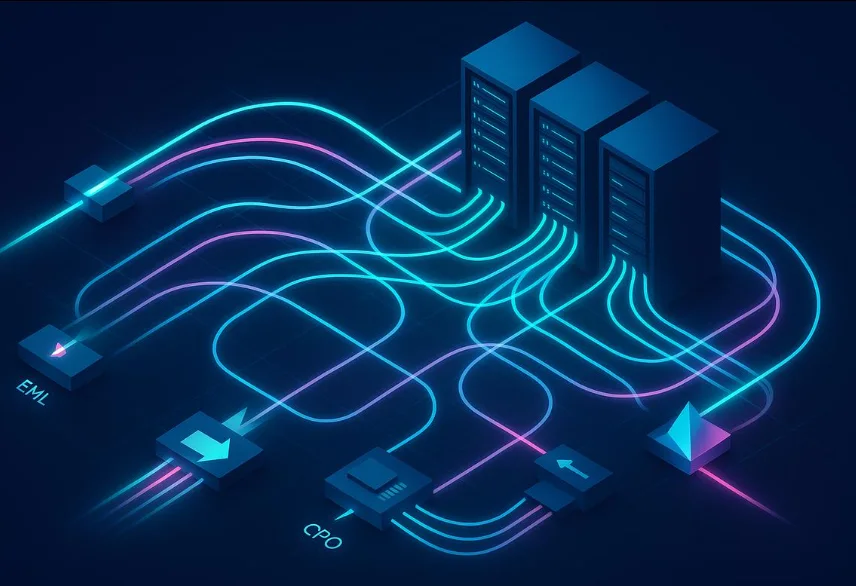
Optical technology addresses this challenge by converting electrical data into light and sending it through fibre. This can carry larger amounts of information over greater distances while consuming less power, making it increasingly important as AI clusters expand.
Lumilens is developing several forms of connectivity, including pluggable optical transceivers, near-package optics and technology that places optical components closer to computing chips. Its LumiCore platform combines silicon photonics, specialised integrated circuits, manufacturing processes and control software.
The new capital will be used to recruit engineers and expand production capabilities. Lumilens has already brought in specialists from established technology companies including Cisco, Juniper Networks, Meta, Marvell, Lumentum and Coherent.
However, replacing copper connections will not happen immediately. Optical components remain more expensive and difficult to manufacture, while reliability and production volume must meet the demanding standards of companies operating enormous data centres continuously.
Even with those challenges, Lumilens’ sudden arrival reveals an important shift in the AI industry. The next competitive advantage may not come exclusively from producing a faster processor or a larger AI model. It may come from building the invisible network of light that allows millions of processors to function as one system.