Hadrian has secured one of the largest technology-funding rounds of the year as investors increase their support for software-controlled factories capable of producing critical equipment at greater speed.
The California-based company raised $1.37 billion through a Series D equity round. WCM Investment Management, Washington Harbour Partners, Valor Equity Partners, 137 Ventures and Baillie Gifford jointly led the financing.
JPMorganChase participated as an anchor co-lead through its Security and Resiliency Initiative. Additional investment came from organisations including Morgan Stanley Wealth Management, Apollo-managed funds, CapitalG, Andreessen Horowitz, Founders Fund and T. Rowe Price.
The financing values Hadrian at $7.87 billion. It arrives only about a year after the company completed a $260 million Series C round, demonstrating how quickly investor interest in advanced manufacturing and defence technology has grown.
Hadrian operates what it calls “Factories-as-a-Service.” Rather than requiring every aerospace or defence company to build a dedicated production plant, customers can use Hadrian’s network to manufacture precision components and increasingly complete industrial systems.
At the centre of these factories is Opus, Hadrian’s AI-powered manufacturing platform. The software interprets engineering designs, schedules production, directs equipment and automates inspection. Robotics and computer-controlled machines then carry out many of the repetitive or technically demanding operations.
Human workers remain part of the process, supervising equipment, maintaining machinery and handling tasks requiring judgement or flexibility. Hadrian says its approach can also reduce the time required to train new manufacturing technicians, helping address a shortage of experienced industrial workers.
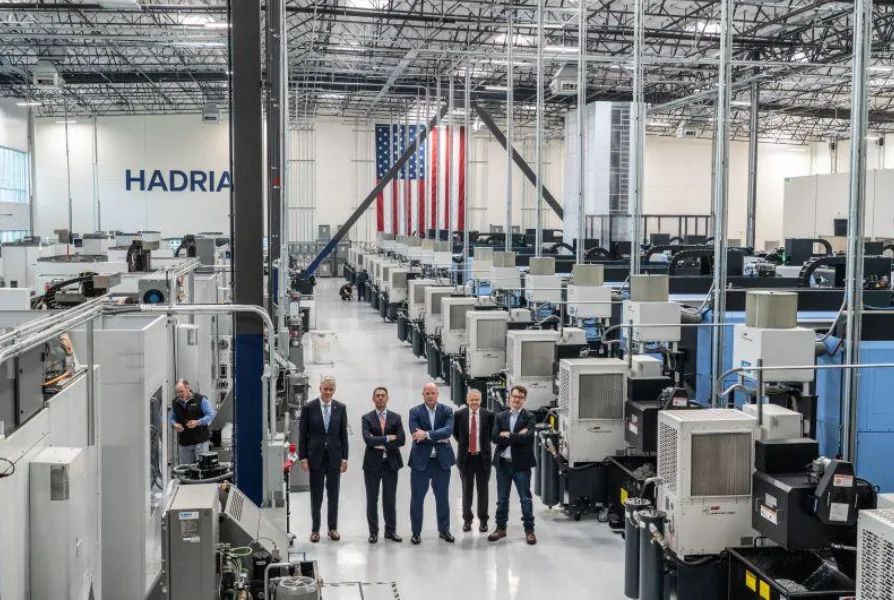
The company currently operates four facilities covering almost three million square feet. Two are located in Torrance, California, while newer factories have opened in Mesa, Arizona, and Muscle Shoals, Alabama.
Hadrian plans to use the new capital to build additional factories, expand research and development and introduce more production capabilities. Its future lines will include equipment for munitions, shipbuilding and autonomous systems.
The expansion represents a significant change in the way heavy industrial technology is financed. For decades, venture investment concentrated heavily on software companies that could grow without factories. The rise of robotics and AI is now attracting investors to businesses where software controls physical production.
Automated manufacturing could reduce delays in aerospace and defence supply chains, where specialised parts often pass through several small suppliers before reaching final assembly. Placing design interpretation, production and quality inspection within a coordinated digital system could shorten that process.
However, Hadrian still faces demanding tests. Aerospace and defence components must meet extremely strict safety and quality standards. Scaling production rapidly while maintaining reliability will be more difficult than expanding an ordinary software service.
The company’s close relationship with the defence sector may also attract debate over the growing flow of private technology investment into weapons and military-production systems. Hadrian argues that strong domestic manufacturing is necessary for national security and industrial resilience.
The announcement illustrates how artificial intelligence is moving beyond chatbots and digital assistants. In Hadrian’s factories, AI is being positioned as an operating layer for machines, workers and production lines—turning computer instructions into physical aircraft, satellites, autonomous vehicles and other complex systems.