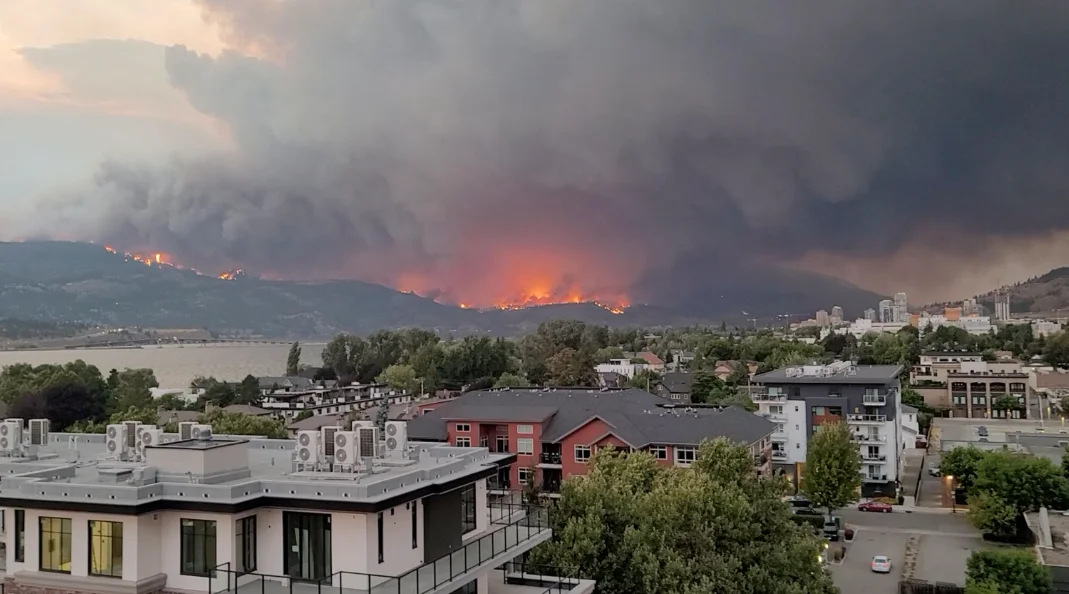
A wall of fire raced through communities along Canada’s Okanagan Lake on Saturday, turning roads into escape routes and forcing more than 20,000 residents to abandon their homes.
The Bald Range wildfire expanded with extraordinary speed under hot, dry and windy conditions. By Saturday, it had covered roughly 9,500 hectares, threatening Summerland, Peachland and neighbouring communities in British Columbia’s southern interior.
Homes and other structures were destroyed as flames approached residential areas. Some people became trapped when evacuation routes deteriorated, forcing emergency crews to rescue dozens of residents by aircraft.
The fire grew powerful enough to create its own weather system. Towering columns of heat and smoke produced lightning, increasing the danger that new fires could ignite beyond the main perimeter.
British Columbia Premier David Eby declared a provincial state of emergency, giving authorities expanded powers to coordinate evacuations, control travel and secure accommodation for displaced families. The disaster became the province’s largest evacuation emergency of the summer.
Highway 97, an essential route through the Okanagan Valley, was closed in affected areas. Power disruptions were also reported, while Summerland issued a boil-water advisory after untreated water entered its supply system.
The emergency struck one of Canada’s best-known wine, fruit-growing and tourism regions during the busy summer period. Beyond the immediate danger to human life, prolonged closures and property destruction could seriously affect farms, vineyards, hotels and small businesses.
More than 100 fires were burning across British Columbia as emergency services confronted unusually dry conditions. Approximately 1,500 personnel were involved in firefighting operations, supported by international crews and aerial resources.
For thousands of evacuees, the most painful uncertainty remained whether their homes would still be standing when they returned. The fire’s speed demonstrated how quickly an ordinary evening can become a mass evacuation when drought, heat and wind converge.