What happened
A European deep-technology company has unveiled a platform designed to connect artificial intelligence directly with physical materials experimentation.
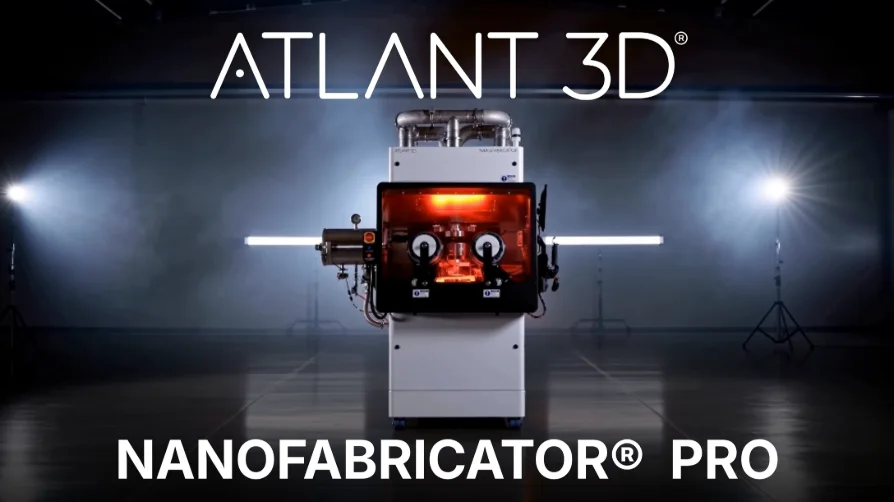
Copenhagen-based ATLANT 3D announced NANOFABRICATOR PRO today, 17 August 2026, describing it as a physical platform built specifically for AI-driven materials discovery.
The system combines extremely precise material deposition with automation and digital control. Instead of relying entirely on conventional laboratory processes, researchers can use the platform to design and manufacture experimental material structures at very small scales.
The company says the technology can work with materials one atomic layer at a time, creating a bridge between AI-generated ideas and real physical experiments.
That distinction is important.
Generative AI can already suggest new materials, molecular structures and experimental possibilities. But discovering something computationally is only part of the process. Scientists still need to manufacture and test those ideas in the physical world.
NANOFABRICATOR PRO is designed to help close that gap.
Why this matters
The announcement could have implications across some of the world's most strategically important technologies.
Modern semiconductors, quantum computers, batteries, sensors and advanced energy systems depend heavily on discovering materials with highly specific physical characteristics.
Traditionally, developing those materials can involve long cycles of designing an experiment, preparing equipment, manufacturing a sample, measuring the results and then repeating the process.
AI can potentially accelerate the design stage dramatically.
But if physical experimentation remains slow, the laboratory becomes the bottleneck.
ATLANT 3D's approach is designed around automating more of that physical process so AI systems and scientists can move more rapidly from a theoretical material to something that can actually be manufactured and examined.
This represents a different dimension of the AI revolution.
The next major breakthroughs may not come only from chatbots or software. They could come from AI systems helping scientists create entirely new physical materials.
Who is affected
The immediate users are likely to be researchers, universities, semiconductor companies and advanced technology laboratories.
But the longer-term impact could reach much further.
Chip manufacturers could use faster materials experimentation to investigate new semiconductor structures as conventional chip scaling becomes increasingly difficult.
Quantum-computing companies need extremely specialized materials and manufacturing processes to create reliable quantum devices.
Battery and energy researchers are continuously searching for materials capable of improving storage capacity, durability and efficiency.
Aerospace and automotive manufacturers also depend on advanced materials that can tolerate extreme temperatures, reduce weight or provide unusual electrical characteristics.
And European governments have increasingly identified semiconductors, quantum technology and advanced manufacturing as strategically important industries.
That makes the Danish announcement relevant not only to scientific research but also to Europe's wider technological competitiveness.
BoonVerse Analysis
The most interesting part of this announcement is not simply the nanofabrication machine itself.
It is the idea of giving AI a physical laboratory.
Much of the current artificial-intelligence boom happens inside computers. Models analyze information, generate software, produce images and predict possible solutions.
Materials science is different.
An AI model might predict that a particular combination of atoms could produce an extraordinary semiconductor or battery material, but eventually somebody must create it.
Platforms capable of automatically manufacturing and testing AI-generated materials could therefore become an important missing layer between artificial intelligence and industrial innovation.
Imagine an AI system proposing hundreds of variations of a semiconductor material.
Instead of researchers manually preparing each experiment, an automated nanofabrication system could potentially manufacture variations, gather experimental data and feed those results back into computational models.
That creates the possibility of a repeating cycle:
AI proposes → machine creates → laboratory measures → AI learns → improved material is proposed.
If this approach becomes commercially practical at scale, materials research could become considerably faster.
There is also a strategic European angle.
Europe has been attempting to strengthen its position in semiconductors, artificial intelligence, quantum technology and advanced manufacturing while reducing dependence on technology developed elsewhere.
ATLANT 3D's announcement shows that European companies may have an opportunity not only in building AI models but in developing the physical infrastructure through which AI interacts with science and manufacturing.
What happens next
The biggest test will be adoption.
ATLANT 3D will need to demonstrate that NANOFABRICATOR PRO can produce meaningful improvements in real research environments rather than simply impressive laboratory demonstrations.
Universities and industrial research teams will want evidence that the platform can shorten experimentation cycles, produce repeatable results and integrate with their existing equipment and workflows.
Another important question will be whether AI-driven laboratories can eventually operate with much greater autonomy.
If experimental results can automatically return to AI systems that design the next experiment, laboratories could gradually evolve toward closed-loop scientific discovery, where machines conduct large numbers of experiments with substantially less manual intervention.
That possibility could transform materials science.
For now, the announcement from Copenhagen represents an important step toward that future: artificial intelligence is beginning to move from predicting what could exist to helping scientists physically build and test it.
Sources
The primary announcement is ATLANT 3D's 17 August 2026 launch statement for NANOFABRICATOR PRO, issued from Copenhagen today.