What happened
UK aerospace and defence technology company SpaceAM has closed a new seed funding round, securing backing from investment manager Foresight alongside funding connected to the UK's Defence Unicorn initiative.
The investment was formally announced in London on 17 August 2026, making this a fresh technology development from today.
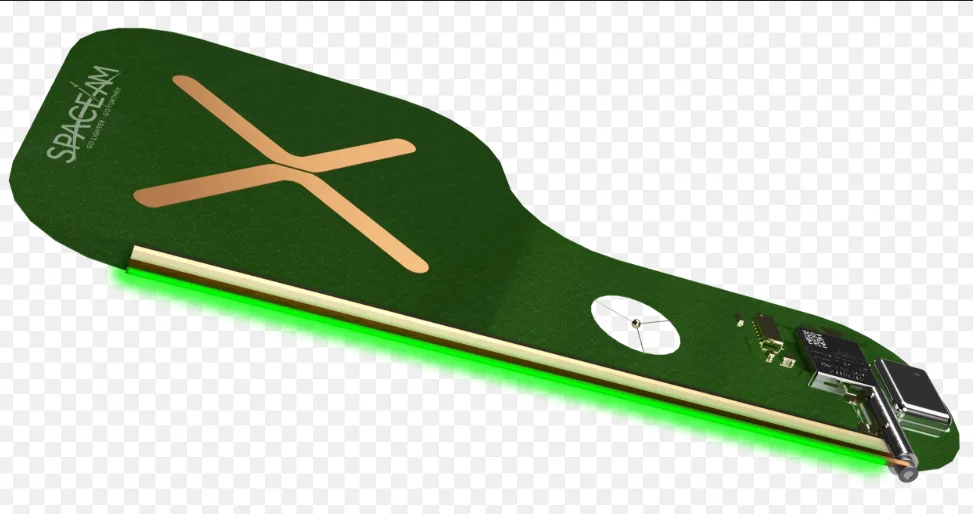
SpaceAM is developing ultra-lightweight autonomous sensor systems designed to gather critical information in places where conventional equipment may be too heavy, expensive or difficult to deploy.
The technology combines specialized hardware with onboard artificial intelligence.
One of its most unusual innovations is a nature-inspired flight system that allows small sensor payloads to slow their descent without relying on conventional parachutes or propulsion systems. Once deployed, onboard AI can process raw sensor information and convert it into useful intelligence in real time.
The technology was originally developed with space exploration in mind, but SpaceAM is now expanding it into defence and security applications.
The company has already secured contracts with both the UK Ministry of Defence and the European Space Agency, while also receiving £2 million in UK government defence funding.
Why this matters
The announcement arrives as Europe rapidly increases investment in defence technology, autonomous systems, artificial intelligence and sovereign technological capabilities.
Modern military operations increasingly depend on information.
Knowing what is happening across a battlefield, coastline, border or remote environment can be as important as the weapons deployed there.
Traditional surveillance systems, however, can be expensive and difficult to place in dangerous locations.
SpaceAM is pursuing a different approach: make sensors smaller, lighter, autonomous and intelligent enough to process information close to where it is collected.
That last capability is particularly important.
Instead of transmitting enormous quantities of raw information elsewhere for analysis, onboard AI can potentially identify useful information immediately.
This can reduce communications requirements and accelerate decision-making in situations where seconds matter.
Who is affected
The most immediate beneficiaries could be European defence and security organizations seeking new intelligence, surveillance and reconnaissance technologies.
The UK Armed Forces are already an important customer. SpaceAM has secured a multi-million-pound Ministry of Defence contract aimed at accelerating procurement of advanced technology for British forces.
The space industry could also benefit.
Because the underlying technology originated in space exploration, lightweight autonomous sensors could potentially be used for scientific measurements and missions where every additional gram of equipment increases launch and deployment costs.
SpaceAM's technology may eventually have applications outside defence as well. Lightweight sensors capable of reaching difficult locations could potentially support environmental monitoring, disaster assessment and other industrial activities, although today's announcement focuses primarily on defence, security and space.
The company itself is also expanding. SpaceAM now has a 13-person team and new research-and-development facilities in Gloucestershire.
BoonVerse Analysis
The most important part of today's announcement is not simply another startup receiving investment.
It represents a broader transformation taking place across Europe's technology industry: AI is escaping the data centre and entering physical machines.
Much of the artificial-intelligence boom has focused on software—chatbots, image generators, coding assistants and enterprise AI.
Defence and aerospace are pushing AI in another direction.
Here, artificial intelligence must operate inside sensors, drones, aircraft, satellites and autonomous machines working in unpredictable physical environments.
That requires more than a powerful AI model.
Hardware must be lightweight. Energy consumption must be low. Communications may be unreliable. Systems may need to make decisions without continuously connecting to enormous cloud data centres.
SpaceAM's combination of specialized hardware, autonomous deployment and onboard AI reflects this emerging concept of physical AI.
There is also a strategic European dimension.
European governments increasingly want important defence technologies developed domestically rather than depending entirely on foreign suppliers.
SpaceAM says its hardware, software and AI capabilities are developed in-house in the UK.
That could become commercially valuable as governments place greater emphasis on technological sovereignty.
The startup has also achieved something particularly important for a young defence company: it already has government customers.
Many defence-tech startups can demonstrate impressive prototypes but struggle to navigate complicated government procurement systems. SpaceAM's existing Ministry of Defence contract and relationship with the European Space Agency provide evidence that its technology has progressed beyond an early laboratory concept.
What happens next
Today's seed round is unlikely to be SpaceAM's final fundraising milestone.
CEO Chris Isaac said the company is preparing for a Series A funding round that would allow it to scale more aggressively.
The newly announced investment will meanwhile support expansion of its product range, improvements to corporate governance and preparations for its next stage of commercial growth.
The crucial test will be whether SpaceAM can turn early government contracts into deployments at much greater scale.
Europe's rapidly changing security environment could provide an opportunity.
Demand for autonomous systems, battlefield intelligence and domestically controlled defence technologies is increasing, while governments are attempting to shorten the traditionally slow process of buying technology from startups.
If SpaceAM successfully converts its early contracts into larger programmes, the small British company could emerge as a notable player in Europe's expanding defence-tech ecosystem.
For now, today's funding announcement sends a clear signal about where investors believe the next technological frontier may lie: AI will not only analyze information on computers it will increasingly travel into the world's hardest-to-reach places and decide what information matters before humans ever see it.
Sources
The primary source is Foresight Group's official 17 August 2026 announcement, which confirms the investment, SpaceAM's technology, its 13-person team, new Gloucestershire R&D facilities, Ministry of Defence and European Space Agency contracts, and £2 million in UK government defence funding.
The same announcement confirms that the new backing will support product development and preparations for SpaceAM's next stage of growth, including its planned move toward a Series A round.