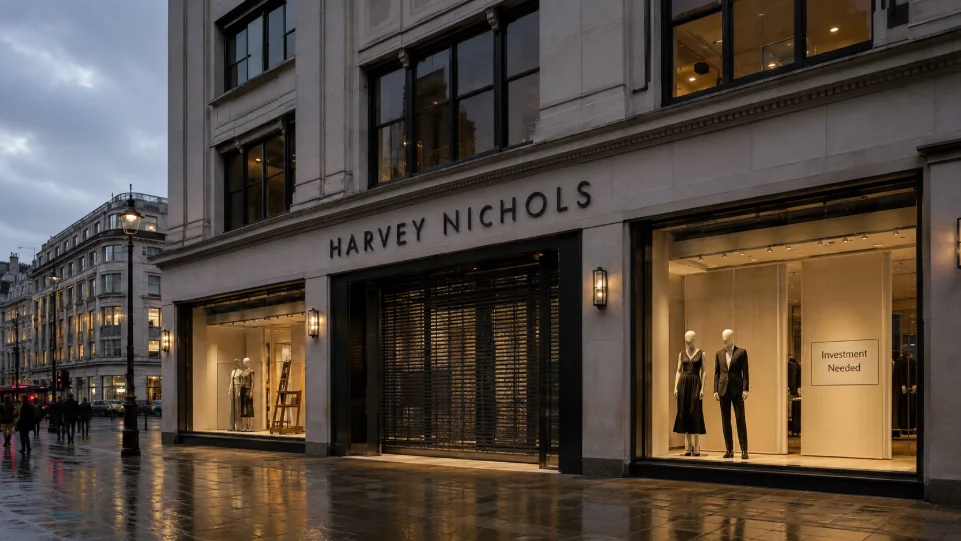
Harvey Nichols, one of Britain’s best-known luxury retail names, has issued a serious warning about its ability to continue operating without an injection of new capital.
Documents connected to the company’s financial position indicate that additional funding or a successful sale will be necessary within the coming year. Although interested bidders have emerged, no rescue agreement had been completed when the warning became public on 10 August.
The retailer has struggled to generate a profit since the disruption caused by the COVID-19 pandemic. Its difficulties have been intensified by reduced spending from international visitors, expensive store operations, changing customer behaviour and growing competition from online luxury platforms.
Recent accounts reportedly show that the business recorded a substantial loss during the financial year ending in March 2025. Although different calculations distinguish operating losses from exceptional accounting charges, the overall picture is of a company whose expenses and liabilities have placed considerable strain on its available resources.
Harvey Nichols’ owner, Hong Kong businessman Sir Dickson Poon, placed the retailer on the market earlier in 2026. Several potential buyers have since examined the business, but the search has not yet produced a binding transaction.
Mike Ashley’s Frasers Group is reportedly among the leading interested parties, with an offer estimated at about £40 million. A successful acquisition could allow Frasers to preserve flagship locations while potentially converting some regional branches into stores operating under its existing luxury brands. These plans remain speculative until a final agreement is announced. Business report published on 10 August
Harvey Nichols operates its celebrated Knightsbridge store in London alongside locations in cities including Birmingham, Leeds, Edinburgh and Manchester. It has also developed an international presence through licensed stores and partnerships.
The company’s prestige has not protected it from the structural changes transforming department-store retail. Luxury consumers increasingly research and purchase products online, while brands are expanding their own shops and digital channels. This reduces the importance of traditional department stores as intermediaries between fashion labels and customers.
High property, staffing and inventory costs make the challenge more severe. Luxury stores must maintain attractive locations and carry expensive products, but slower sales can leave significant amounts of money locked inside unsold stock.
Leadership changes have accompanied the financial uncertainty. Poon stepped down as a director in May, while Julia Goddard is now leading the business through its search for investment and a more sustainable operating model.
Why This Matters
The potential failure of Harvey Nichols would represent more than the disappearance of a famous retail name. It would affect employees, suppliers, landlords and luxury brands that depend on its stores for distribution and visibility.
Its difficulties also provide a warning to other premium retailers: heritage and name recognition cannot replace digital investment, operational discipline and a clear reason for customers to visit physical stores.
A buyer could give Harvey Nichols time to modernise, reduce costs and concentrate on its strongest locations. Without a completed transaction or fresh financing, however, the company’s future will remain uncertain.