What happened
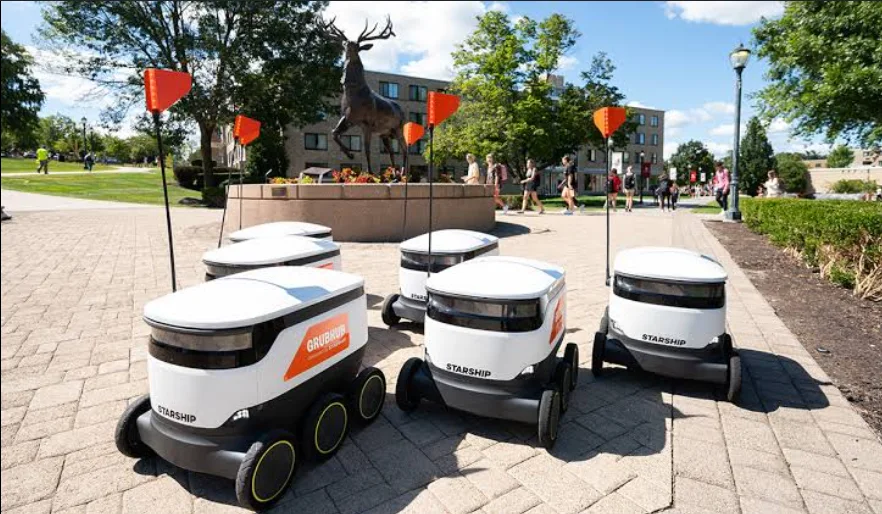
America's autonomous-delivery industry took another significant step forward on 17 August 2026, when Serve Robotics and Grubhub announced a partnership bringing robotic delivery directly into the Grubhub marketplace.
The rollout will begin in Chicago, Los Angeles and Alexandria, Virginia, according to the companies' announcement.
The concept is straightforward.
Instead of every eligible restaurant order being collected by a person driving a car, riding a bicycle or using another conventional transportation method, some deliveries can be assigned to an autonomous sidewalk robot.
Serve's machines are designed to navigate urban environments and transport orders to customers without a human physically driving them throughout the journey.
The partnership matters because it connects autonomous robots with an established food-delivery marketplace rather than requiring consumers to adopt an entirely separate robotic-delivery service.
It is also part of a broader expansion announced by Serve today, covering multiple areas of the company's operations.
Why this matters
The difficult and expensive final part of delivering something to a customer is commonly known as the last mile.
A meal may be prepared quickly.
A product may already be sitting inside a nearby store.
But somebody—or increasingly something—still needs to move it the final few kilometres to the customer.
That process requires time, labour and transportation.
Autonomous robots could change the economics of certain short-distance deliveries.
For suitable orders, a small electric robot does not need petrol, a driver's seat or continuous human control.
It can potentially transport relatively lightweight products while occupying far less road space than a conventional delivery vehicle.
This doesn't mean robots can replace every courier.
Long journeys, difficult terrain, large orders, stairs, severe weather and complicated destinations remain challenging.
But even automating a portion of millions of short urban deliveries could create a substantial commercial market.
Who is affected
Grubhub customers in the initial cities could begin encountering autonomous delivery as another way their orders reach them.
Restaurants may gain access to additional delivery capacity without having to operate their own robotic fleets.
Delivery workers face a more complicated impact.
Robots are unlikely to eliminate human delivery work overnight, but automation could increasingly handle the simplest short-distance journeys.
That could gradually change which deliveries are assigned to people.
Cities and pedestrians will also be affected.
If robotic delivery scales substantially, sidewalks could increasingly become transportation infrastructure for autonomous machines as well as people.
Municipal governments may consequently need clearer rules governing speed, accessibility, right-of-way and where robots can operate.
BoonVerse Analysis
The bigger story is not one robot carrying somebody's lunch.
It is the emergence of an entirely new autonomous logistics layer underneath American cities.
Consider what is happening simultaneously across the delivery industry.
Some companies are developing drones.
Others are building autonomous cars.
Serve is concentrating on sidewalk robots.
Traditional human couriers remain essential.
The likely future may therefore not involve one technology completely replacing all the others.
Instead, delivery platforms could become intelligent transportation networks capable of choosing the most efficient option for every individual order.
A system could eventually determine:
Short journey + small order + suitable sidewalks → robot.
Longer urban journey → human courier or autonomous vehicle.
Lightweight order + suitable airspace → drone.
The consumer might never make that decision.
Software could automatically select the cheapest and fastest available transportation method.
That is why today's Grubhub partnership deserves attention.
Grubhub already provides the marketplace connecting consumers and restaurants. Serve provides the physical autonomous machines.
Combining the two allows robotic delivery to become a feature inside an established consumer platform rather than remaining an isolated technology experiment.
There is also an increasingly interesting competitive battle emerging.
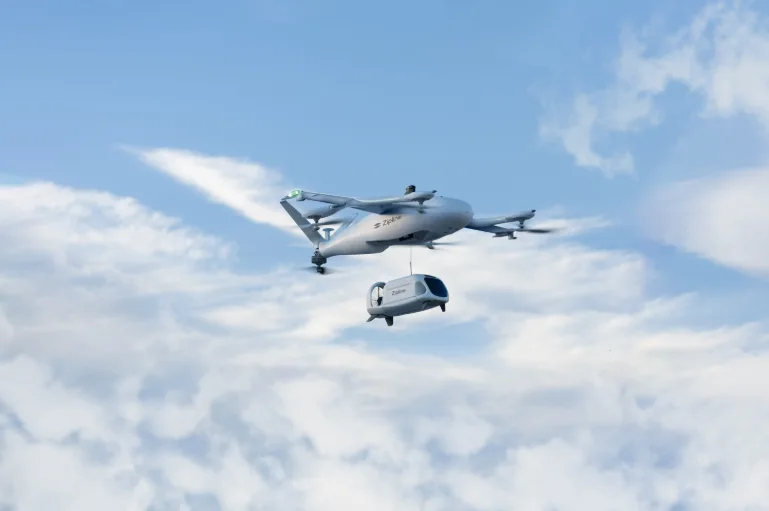
Uber and Zipline announced their own large-scale drone-delivery partnership today, while Serve and Grubhub are expanding delivery at ground level.
The American delivery market is therefore becoming a testing ground for several forms of autonomous transportation at once.
The question is shifting from:
“Can a robot deliver food?”
to:
“Which autonomous delivery technology can become profitable at citywide scale?”
What happens next
Chicago, Los Angeles and Alexandria will provide important real-world tests.
Serve and Grubhub will need to demonstrate that robots can complete deliveries reliably while safely navigating sidewalks shared with pedestrians, pets, bicycles and other obstacles.
Customer behaviour will matter just as much as engineering.
People need to find robotic delivery sufficiently convenient to continue using it after the novelty disappears.
Restaurant adoption will also be critical.
A successful autonomous-delivery network needs enough participating merchants and orders to keep robots operating productively rather than sitting idle.
Regulation could become another major factor as fleets expand.
A handful of robots operating within limited areas attracts relatively little attention. Hundreds or thousands operating continuously across cities could force municipalities to rethink how public sidewalks are shared with autonomous machines.
If the initial deployments work economically, expansion into additional Grubhub markets would be the logical next step.
Today's announcement therefore represents something larger than another food-delivery partnership.
America is beginning to test whether autonomous robots can move from technology demonstrations into ordinary urban infrastructure—and whether millions of consumers will eventually consider receiving dinner from a machine completely normal.
Sources
The strongest primary confirmation comes from Serve Robotics' 17 August 2026 announcement, which confirms the Grubhub partnership and initial deployment in Chicago, Los Angeles and Alexandria.
The same announcement was filed with the U.S. Securities and Exchange Commission, independently confirming the date, participating companies and initial cities.