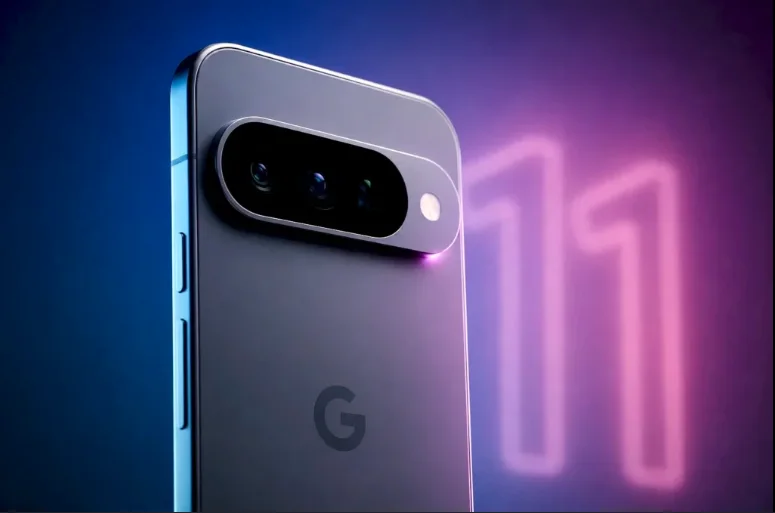
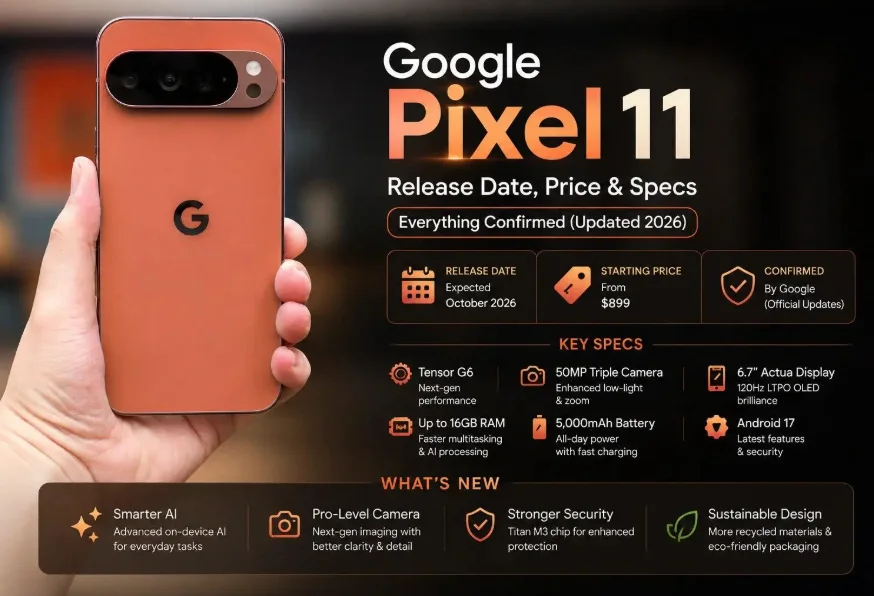
Google has pushed artificial intelligence deeper into everyday mobile life with the launch of its Pixel 11 smartphone family, one of the biggest technology announcements of 12 August 2026.
The new generation includes the Pixel 11, Pixel 11 Pro, Pixel 11 Pro XL and foldable Pixel 11 Pro Fold. Google also expanded its hardware ecosystem with the Pixel Watch 5, upgraded Pixel Buds and its first item-tracking accessory, the Pixel Tag.
At the heart of the new phones is Google’s Tensor G6 processor. The company says the chip delivers 25% faster web browsing and opens applications 15% more quickly than its predecessor. Its expanded AI-processing capacity allows compatible tasks to run on the device up to 3.5 times faster while consuming considerably less energy.
That local processing is important because Google is positioning Gemini as more than a chatbot waiting for commands. On Pixel 11, the assistant is designed to understand context, connect information across supported services and present help before the owner begins searching through applications. Some features, however, will depend on the user’s country, language and subscription.
Google has also introduced a distinctive notification feature called HiLight on the Pixel 11 Pro and Pro XL. Coloured LEDs surrounding the camera flash can indicate incoming calls or show whether Gemini is listening, processing a request or preparing a response. Users can assign different colours to important contacts, allowing them to identify certain callers while the phone remains face down.
Photography remains central to the Pixel brand. The standard Pixel 11 receives a new 48-megapixel main sensor that Google says captures 56% more light, improving photographs and videos in darker conditions. Its 5x telephoto camera supports up to 30x Super Zoom.
The Pro models go further with an upgraded 48-megapixel telephoto camera, Portrait Mode at 5x zoom and AI-assisted Pro Zoom reaching as far as 120x. Improvements to the image-processing system also allow Night Sight to capture low-light photographs faster.
Design changes are less dramatic but practical. Google reduced the standard Pixel 11’s camera-bar thickness by 40%, helping it sit more steadily on a flat surface when paired with an official case. The Pro models feature displays capable of reaching 3,600 nits of brightness and a coating designed to offer more than twice the scratch resistance of the previous generation.
The company has also embraced faster charging and magnetic accessories. Every model begins with 256GB of storage and includes built-in Pixelsnap support. The Pixel 11 and Pixel 11 Pro support Qi 2.2 wireless charging at up to 25 watts, while Google claims the Pro XL can gain approximately 15 hours of battery life from a 15-minute wired charge.
Security receives a notable upgrade through the Tensor G6 and new Titan M3 security chip. Google says the combined system brings post-quantum cryptography into the phone’s secure-boot process, an attempt to prepare devices for future attacks involving more powerful computing systems.
The foldable model brings another ambitious feature: sign-to-text communication. The Pixel 11 Pro Fold can use its camera and two displays to translate American Sign Language into text through supported Google accessibility tools. It is also almost 10% lighter, approximately one millimetre thinner and three times more durable than the previous model, according to Google.
The Pixel 11, Pixel 11 Pro and Pixel 11 Pro XL are available for preorder at starting prices of $899, $1,099 and $1,299 respectively. They are expected to reach Google stores and participating retailers on 20 August, although prices and availability will differ between markets.
The announcement shows where the smartphone industry is heading. Competition is no longer centred only on camera resolution, display brightness or processor speed. The next contest is about which device can understand its owner, anticipate useful actions and deliver that assistance without making technology feel more intrusive.
Google’s advantage is its control over Android, Gemini, custom processors and Pixel hardware. The challenge will be proving that proactive AI can become genuinely useful and trusted outside carefully prepared launch demonstrations.