Product at a Glance
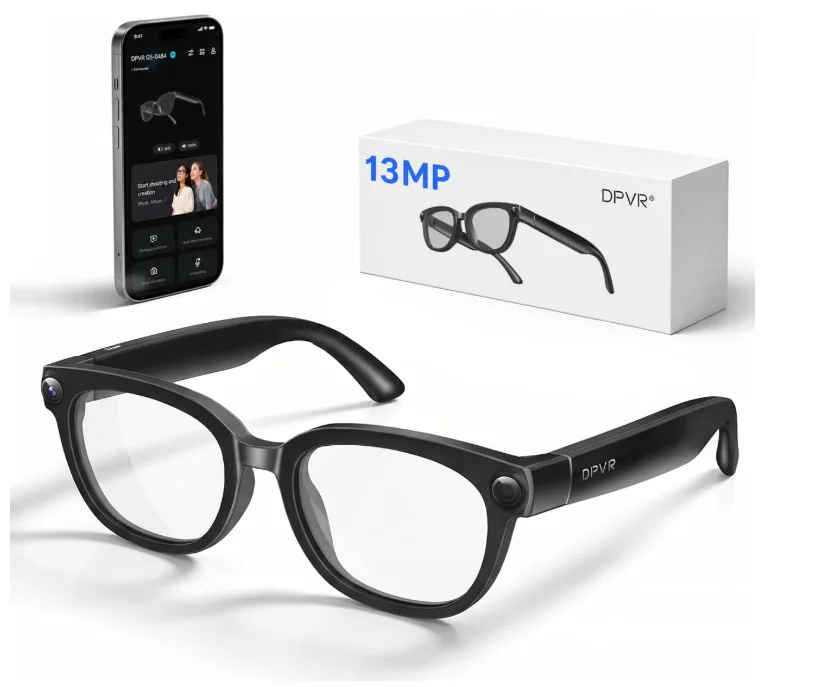
Product: DPVR G5 AI Smart Glasses
Category: AI smart glasses / camera glasses
Camera: 13MP
Video: First-person HD video recording
Connectivity: Bluetooth 5.4 and Wi-Fi 6
Audio: Open-ear speakers with built-in microphones
AI: Voice assistant, image recognition, translation and voice notes
Storage: 32GB
Battery: 290mAh
Weight: Approximately 48g
Protection: IP54
Best for: Travel, hands-free recording, work, everyday AI assistance and POV content creation
BoonVerse Rating: 8.4/10
DPVR officially describes its G5 series as combining a 13MP camera with voice control, music playback, calls and AI-assistant functions. The standard G5 is positioned as the everyday model in the lineup.
Product Overview
Smart glasses are moving beyond experimental gadgets and becoming practical wearable devices, and the G5 AI Smart Glasses are an interesting example of that shift.
Instead of placing a screen directly in front of your eyes, the G5 focuses on something potentially more useful for everyday users: capturing, listening and interacting with AI without constantly holding a smartphone.
A 13MP camera is integrated into the frame, allowing users to take first-person photos and videos. Bluetooth audio lets the glasses handle calls, music and voice interactions, while AI features extend their usefulness to object recognition, translation and general voice assistance.
The concept is simple: your glasses become another interface between you, your smartphone and AI.
That could make the G5 particularly attractive to travelers, content creators, cyclists, technicians and people who regularly need their hands free.
Key Specifications
| Specification | G5 AI Smart Glasses |
|---|---|
| Camera | 13MP |
| Photo/Video | First-person photo and video capture |
| Stabilization | Electronic image stabilization |
| AI Assistant | Yes |
| AI Image Recognition | Yes |
| Translation | Supported through AI/app features |
| Voice Notes | Supported |
| Speakers | Open-ear audio |
| Microphones | Dual noise-reduction microphones |
| Bluetooth | Bluetooth 5.4 |
| Wi-Fi | Wi-Fi 6 |
| Storage | 32GB |
| Battery | 290mAh |
| Weight | Approx. 48g |
| Water/Dust Resistance | IP54 |
| Lens | Adaptive/photochromic depending on version |
| Wear Detection | Yes |
| Controls | Voice and physical temple control |
| Smartphone Integration | Companion app |
Published G5 product information lists a 13MP camera, 48g weight, 290mAh battery, Bluetooth 5.4, Wi-Fi 6, IP54 protection and 32GB storage.
What the Specifications Mean
13MP Camera
The 13-megapixel camera is one of the biggest attractions.
Unlike holding a smartphone in front of you, camera glasses capture footage from roughly your natural point of view. That can make videos feel more immersive because viewers see an experience closer to the way you saw it.
The 13MP sensor should also provide more image detail than the 8MP cameras found on many lower-cost smart glasses. Independent coverage of the G5 has similarly highlighted the resolution advantage of its 13MP sensor.
However, megapixels alone do not determine image quality. Lighting, image processing, stabilization and lens quality remain important.
32GB Storage
Built-in storage is particularly useful for recording.
Instead of depending entirely on your phone during every capture, local storage gives the glasses room for photos and video files before they are transferred or managed.
Bluetooth 5.4
Bluetooth connects the glasses to your smartphone for functions such as calls, audio playback and app-based smart features.
Bluetooth 5.4 should provide a modern wireless connection while helping keep power consumption under control.
290mAh Battery
A 290mAh battery is reasonable for lightweight eyewear, but users should remember that recording video, wireless communication and AI-related functions can consume substantially more power than simple Bluetooth music playback.
Battery life should therefore be judged according to how you plan to use the glasses rather than battery capacity alone.
Design & Build
One of the biggest challenges facing smart-glasses manufacturers is making wearable technology that people actually want to wear.
The G5 takes a relatively conventional eyewear approach.
Rather than looking like a miniature VR headset, much of the electronics are incorporated into the temples and frame. At approximately 48 grams, it remains relatively lightweight considering the camera, speakers, microphones, battery and wireless hardware inside.
DPVR has also expanded the G5 concept into different designs, including the standard G5, fashion-focused G5 Crystal, and sport-oriented G5 Pilot.
The standard model is likely the safest option for people who want something suitable for commuting, work, travel and casual use.
Key Features Explained
1. Hands-Free Photo and Video Recording
This is arguably the G5's most practical feature.
You can capture something from your own perspective without first pulling out a smartphone, opening the camera and positioning it.
Depending on the function being used, capture can be activated through a physical control or voice command.
That could be valuable when walking through a city, sightseeing, demonstrating equipment or creating POV content.
2. AI Voice Assistant
The G5 isn't simply a camera attached to glasses.
Its AI assistant provides voice-based interaction, with product information describing support for continuous conversations after the assistant has been activated.
That creates the possibility of asking follow-up questions while keeping your hands occupied.
For example, a traveler could ask about something nearby, follow up with another question and continue walking without repeatedly taking out a phone.
3. AI Image Recognition
The camera can also become an input for AI.
Image-recognition functionality is designed to help identify objects, scenes and landmarks viewed through the glasses.
This could eventually become one of the most useful categories of smart-glasses functionality because the AI gains visual context about what the wearer is looking at.
4. Real-Time Translation
Translation makes smart glasses particularly interesting for international travelers and multilingual workplaces.
The G5's AI tools can assist with translating conversations through its companion software.
Rather than repeatedly typing sentences into a translation app, the wearable format can make language assistance feel more natural.
Users should still expect accuracy to vary by language, accent, background noise and internet connectivity.
5. Open-Ear Audio
Built-in speakers deliver sound without putting earbuds inside your ears.
That means you can listen to music, hear AI responses or take calls while remaining more aware of your surroundings.
For walking, commuting and certain workplace environments, that awareness can be a meaningful advantage over conventional earbuds.
6. Bluetooth Calling
The combination of open-ear speakers and integrated microphones turns the G5 into a wearable Bluetooth headset.
Calls can therefore be handled without holding your smartphone against your ear.
Dual noise-reduction microphones are intended to improve voice pickup during calls and voice commands.
7. Voice Notes
An idea can disappear quickly.
Voice-note functionality makes it possible to capture spoken thoughts while moving, with AI-assisted speech-to-text functionality potentially making those notes easier to review later.
That could be especially useful for entrepreneurs, journalists, students, engineers and field workers.
Real-World Use Cases
Travel: Capture attractions from your perspective, use AI to learn about landmarks and access translation tools when communicating.
Vlogging: POV recording can produce more natural footage while leaving both hands free.
Work: Technicians and field workers could record procedures or document what they are seeing while continuing to work.
Cycling and outdoor activities: Hands-free recording is far more convenient than trying to operate a smartphone, although users should never allow the device to distract them from road safety.
Events: Capture short first-person memories without watching the entire experience through a smartphone screen.
Learning: Image recognition and AI questioning could help users investigate unfamiliar objects or places.
Calls and music: During ordinary daily use, the G5 can function as open-ear Bluetooth audio glasses.
Who Should Buy It
The G5 makes the most sense for:
- Travelers who frequently take photos and videos.
- POV vloggers and social-media creators.
- Technology enthusiasts interested in wearable AI.
- Professionals who need hands-free documentation.
- Users who regularly make Bluetooth calls.
- People interested in AI translation and visual recognition.
- Cyclists, walkers and outdoor users who prefer open-ear audio.
- Users who want smart-glasses features without moving into expensive display-based AR eyewear.
Who Should Skip It
The G5 may not be the right choice if your primary goal is professional photography or filmmaking. A modern flagship smartphone, action camera or dedicated camera offers far more creative control.
Privacy-conscious buyers should also think carefully about owning always-accessible camera eyewear.
Skip it if you mainly want:
- A full augmented-reality display.
- Professional-quality filmmaking.
- All-day continuous video recording.
- A replacement for your smartphone.
- Premium prescription eyewear without checking lens compatibility first.
- A mature software ecosystem comparable with the biggest consumer technology platforms.
Advantages
13MP camera: Higher resolution than many inexpensive 8MP camera glasses.
True POV capture: Records from close to the wearer's natural perspective.
Hands-free operation: One of the biggest advantages over smartphone recording.
AI integration: Voice assistance, visual recognition and translation increase its usefulness beyond recording.
Open-ear speakers: Calls and audio remain accessible without blocking your ears.
Bluetooth 5.4: Modern wireless connectivity.
32GB storage: Useful for locally storing captured content.
Lightweight construction: Approximately 48g is impressive considering the amount of hardware packed inside.
Wear detection: Adds convenience and can help manage unnecessary operation.
Limitations
Battery Constraints
A small wearable cannot offer the battery capacity of a smartphone or action camera. Frequent video recording, Wi-Fi use and AI functions will naturally place more pressure on the battery.
Camera Isn't a Smartphone Replacement
The 13MP number sounds impressive, but buyers shouldn't interpret it as meaning the glasses will outperform a premium smartphone camera.
Privacy Concerns
Camera-equipped glasses require responsible use.
Recording people without their knowledge may be inappropriate and can be illegal depending on the location and circumstances. Users should respect local privacy and recording laws.
AI May Depend on Connectivity
Some advanced AI and translation features can depend on the companion smartphone, app or internet connection.
Software Matters
Smart glasses depend heavily on companion software. Long-term value will therefore depend partly on DPVR continuing to improve its applications, AI integration and firmware.
Alternatives
Ray-Ban Meta Smart Glasses
The most obvious premium alternative is Ray-Ban Meta. Models in the established lineup offer a 12MP ultra-wide camera, open-ear audio, video recording and AI functionality.
Amazon smart-glasses market tracking from June 2026 placed Ray-Ban Meta among the strongest-selling products in the category.
Its biggest advantages are the established Ray-Ban design, Meta ecosystem and more mature consumer presence.
The G5, however, may appeal to shoppers interested in a 13MP camera, broader experimentation with AI features and potentially lower pricing.
Lower-Cost 8MP AI Glasses
Amazon also contains a growing number of 8MP AI camera glasses offering translation, Bluetooth audio and video recording.
They can be cheaper, but hardware quality, companion applications, privacy controls and long-term software support can vary considerably.
Value for Money
The G5 occupies an interesting position between inexpensive generic camera glasses and more established premium smart eyewear.
Its value comes from combining several devices:
Camera + Bluetooth headset + open-ear headphones + voice recorder + translation assistant + AI image-recognition device.
If you would genuinely use several of those functions, the proposition becomes much stronger.
If you only want Bluetooth music or occasional photography, ordinary headphones and your existing smartphone will probably deliver better value.
Amazon's smart-camera-glasses category has become highly competitive, with market tracking showing particularly heavy product concentration in the $50–$100 range during 2026.
That competition means buyers should compare the current G5 price carefully before purchasing.
BoonVerse Analysis
The most interesting thing about the G5 isn't simply its 13MP camera.
It is the transition from smart glasses as a recording gadget to smart glasses as an AI interface.
Smartphones require deliberate interaction: take the phone out, unlock it, open an application and point the camera.
Wearable AI removes several of those steps.
The G5 can already see through its camera, hear through its microphones, communicate through its speakers and connect to AI through software. That combination gives a glimpse of where personal computing may be heading.
DPVR's decision to introduce multiple G5 designs also matters. The company announced the standard G5 alongside the fashion-oriented G5 Crystal and sport-focused G5 Pilot, suggesting that smart eyewear is beginning to compete not only on specifications but also on where and how people want to wear it.
The challenge will be software.
Camera resolution can attract buyers, but reliable AI, translation accuracy, privacy controls, battery management and a polished companion application will determine whether people continue using these glasses after the novelty wears off.
BoonVerse Verdict
Rating: 8.4/10
The G5 AI Smart Glasses are a compelling option for buyers who want affordable access to hands-free AI and first-person recording without wearing a bulky headset.
The 13MP camera, 32GB storage, Bluetooth 5.4, open-ear audio, AI recognition, translation and lightweight 48g frame create an unusually broad feature package.
They are particularly attractive for travel, POV videos, everyday recording and experimentation with wearable AI.
But don't buy them expecting a smartphone camera replacement or futuristic AR display. Their strength is convenience: seeing, recording, listening and interacting with AI while keeping your hands free.
For the right user, that convenience could make the G5 one of the more interesting smart-glasses options to watch in 2026.
Amazon Purchase Link
Prices, availability, colors and specifications can change, so confirm that the listing specifically states G5 / 13MP before ordering.
Check G5 AI Smart Glasses on Amazon
Affiliate Disclosure
Affiliate Disclosure: BoonVerse participates in the Amazon Associates Program. If you purchase a product through an Amazon link on this page, BoonVerse may earn a commission from qualifying purchases at no additional cost to you. Our product analysis and editorial opinions are intended to remain independent of affiliate partnerships.
Sources & Research
This review was prepared using available manufacturer/product information, current smart-glasses market data and independent product coverage. Specifications and software features may vary by market, firmware version or individual G5 configuration.
Research references:
- DPVR G5 Series announcement — confirms the 13MP camera, AI assistant, hands-free photo/video capture, calling, music functionality and G5 family positioning.
- G5 product information — details including 13MP camera, 48g weight, Bluetooth 5.4, 290mAh battery, Wi-Fi 6, IP54 protection and 32GB storage.
- Independent recording-glasses comparison — discusses the G5's 13MP sensor and positioning against competing 8MP smart glasses.
- Amazon smart-glasses market research — provides category pricing, sales and competitive-product context.