What happened
Equinor announced on Monday, 17 August 2026, that it has signed a definitive agreement to acquire 87.71% of the Class A shares in the Lackawanna Energy Center, a major gas-fired power station in Pennsylvania.
The agreed price is approximately $940 million, although Equinor says the final amount could be reduced at closing under provisions contained in the transaction agreement.
The interest is being acquired from funds managed by Global Infrastructure Partners, part of BlackRock. The plant's developer, Invenergy, will continue managing and operating the facility after the transaction.
Lackawanna is no small power station.
The facility has approximately 1,483 megawatts of generating capacity and consists of three combined-cycle units containing gas turbines, steam turbines, generators and heat-recovery systems. It began commercial operations in January 2019 and generates close to 9 terawatt-hours of electricity annually.
But the location may be just as important as the plant itself.
Lackawanna operates inside PJM, the largest wholesale electricity market in the United States, serving nearly 70 million consumers across 13 states.
Why this matters
The deal arrives at a critical moment for America's electricity industry.
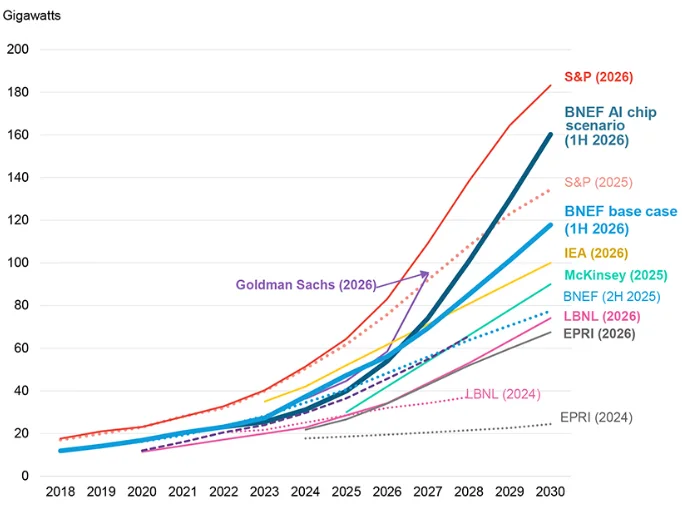
Artificial intelligence is driving companies to construct enormous data centers filled with power-hungry processors. At the same time, electrification, manufacturing investment and broader economic activity are increasing pressure on electricity systems.
Equinor specifically identified data centers, electrification and industrial activity as drivers behind rapidly rising electricity demand in the PJM region.
That makes reliable power-generation assets increasingly valuable.
A giant data center cannot simply stop operating whenever renewable generation falls.
Cloud providers and AI companies need electricity continuously, creating demand for generation that can operate when required.
Gas-fired power stations are therefore becoming an important—and controversial—part of America's attempt to meet rapidly growing electricity demand while renewable generation and grid infrastructure continue expanding.
Who is affected
Electricity consumers across the PJM region are indirectly affected because the market serves roughly 70 million people across 13 states.
Data-center developers are particularly important. New AI and cloud facilities require enormous quantities of dependable electricity, making generation capacity increasingly important when companies decide where to locate future computing infrastructure.
Pennsylvania's energy industry could also benefit from continued investment in regional electricity generation.
Equinor already possesses a major natural-gas position nearby.
Its non-operated Appalachian Basin assets deliver more than 1.7 billion cubic feet of natural gas per day into the northeastern United States.
That geographic relationship creates an interesting strategic position: Equinor already participates in producing natural gas in the region, and it is now investing heavily in infrastructure capable of converting gas into electricity.
Investors are affected as well. The investment gives Equinor additional exposure to the U.S. electricity market while providing what the company describes as preferred upfront cash flow and visibility into longer-term cash generation.
BoonVerse Analysis
The most important part of this $940 million transaction may be two words in Equinor's announcement:
data centers.
The artificial-intelligence boom is beginning to reshape industries far beyond software and semiconductor manufacturing.
First came extraordinary demand for GPUs.
Then came enormous investments in data centers.
Now the pressure is moving further down the infrastructure chain toward electricity generation, transmission, natural gas and grid capacity.
That creates an unusual situation.
Some of the biggest financial beneficiaries of the AI revolution may ultimately include companies that don't develop AI models at all.
An AI model cannot operate without chips.
Those chips cannot operate without data centers.
And those data centers cannot operate without reliable electricity.
The business opportunity therefore extends through the entire infrastructure chain.
Equinor's deal illustrates how global energy companies are positioning themselves for that opportunity.
There is another strategic advantage hiding in the geography.
Lackawanna sits close to Equinor's substantial Appalachian natural-gas position.
That means Equinor is building exposure at multiple points in the same energy ecosystem—from gas production to electricity generation and potentially the rapidly growing industrial and computing customers consuming that electricity.
But the strategy also faces a major challenge.
Gas generation produces carbon emissions, while technology companies are simultaneously making ambitious clean-energy commitments.
America therefore faces a difficult equation:
AI needs enormous amounts of electricity immediately, while the energy system is simultaneously expected to become cleaner.
How the country resolves that conflict could become one of the defining infrastructure questions of the AI era.
What happens next
The acquisition has been announced, but it has not yet closed.
Equinor says completion remains subject to customary regulatory approvals.
Once completed, Invenergy will continue operating and managing Lackawanna rather than Equinor taking direct operational control.
The two companies also plan to explore additional opportunities together within the PJM market, potentially making today's transaction the beginning of a broader relationship rather than a one-off investment.
The bigger development to watch will be electricity demand.
If America's AI data-center construction continues at its current pace, competition for reliable power could intensify across markets such as PJM.
That could increase the strategic value of existing large-scale power stations—particularly facilities located close to abundant fuel supplies and major electricity-demand centers.
For Equinor, today's $940 million agreement is therefore more than another energy acquisition.
It is a bet that one of the most valuable commodities of the AI era may not be an algorithm or a semiconductor.
It may simply be electricity available exactly when enormous computers need it.
Sources
The primary source is Equinor's official announcement issued 17 August 2026, confirming the $940 million transaction, 87.71% Class A interest, 1,483-MW capacity, PJM exposure and regulatory requirements.
Equinor — official 17 August announcement
The same primary disclosure provides technical information on Lackawanna's generation, its relationship with Invenergy and Equinor's Appalachian natural-gas position.