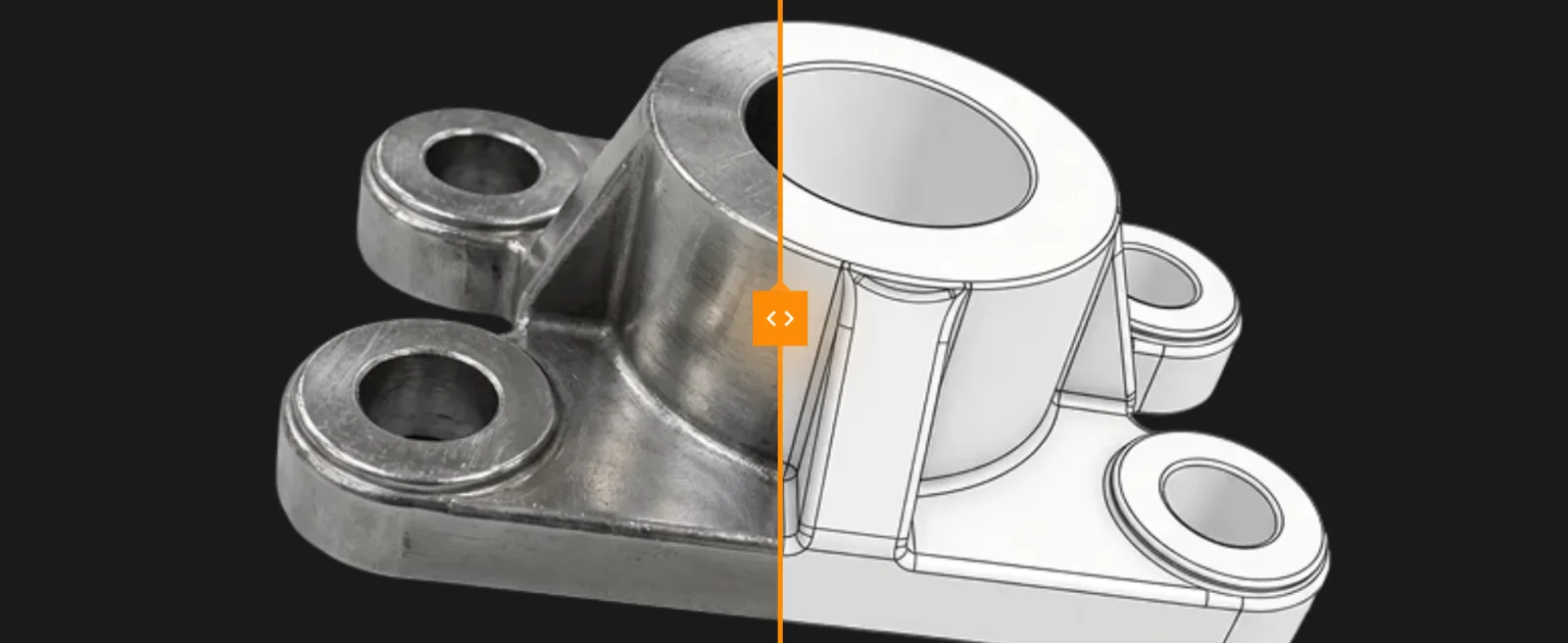
Backflip AI has released an artificial-intelligence system designed to automate one of the most time-consuming processes in mechanical engineering: converting a scanned physical object into an editable CAD model.
Announced on 4 August 2026, the Backflip AI CAD Copilot uses a specialised foundation model to analyse 3D scans and reconstruct their geometry using standard engineering operations.
The tool is generally available through an add-in for Autodesk Fusion and as a standalone web application.
From a static mesh to editable CAD
A 3D scanner can record the shape of an object as millions of data points. However, the resulting mesh is not equivalent to a parametric engineering model.
Mesh files, including the widely used STL format, normally describe only the external surface of an object. They may not contain editable dimensions, manufacturing features or a record of how the component was designed.
Converting this information into usable CAD traditionally requires an experienced engineer to study the scanned part and manually rebuild it.
Backflip’s new model attempts to automate this process by reconstructing the object with familiar CAD operations, including:
- Extrusions
- Revolves
- Patterns
- Holes and cut features
- Parametric dimensions
- Ordered feature histories
The completed model contains a feature tree that engineers can inspect and modify inside compatible CAD software.
AI trained specifically for engineering geometry
According to Backflip, most general-purpose AI models have limited understanding of three-dimensional engineering geometry because their knowledge emerges mainly from training on internet text and images.
The company says its second-generation foundation model was trained with CAD operations as fundamental components. It examines the overall geometry and then reconstructs the part feature by feature, following a process similar to the one used by a human CAD engineer.
This is an important distinction because an accurately shaped model may still be difficult to edit if its construction history does not follow logical engineering conventions.
Fast and Thinking modes
The CAD Copilot provides two reconstruction options.
Fast mode processes typical geometry within a few minutes and may produce several alternative model constructions. These alternatives could use different combinations of extrusions, revolutions and other operations.
Thinking mode gives the AI more processing time to examine complex parts, check its work and improve dimensional accuracy. It produces a more carefully evaluated reconstruction where higher fidelity is required.
Backflip says the current system performs particularly well with moderately complex components produced through three-axis CNC milling and turning. Its applications may also extend to 3D printing and other manufacturing processes.
Potential applications in factories
Many factories operate equipment for which the original CAD files are missing. Production machinery may have been installed by an external company, the original manufacturer may no longer produce replacement parts or the equipment may predate modern digital design systems.
When such a component breaks, engineers must sometimes reverse-engineer it before a replacement can be manufactured.
Automatically converting a scan into editable CAD could help companies:
- Recreate discontinued machine components
- Manufacture replacement parts more quickly
- Reduce production-line downtime
- Digitise inventories of older components
- Modify existing parts for new applications
- Prepare scanned objects for CNC machining or 3D printing
Backflip claims its technology can reduce the cost of digitising a physical component from approximately $1,500 to around $10 in some cases. This is a company estimate and will vary according to a component’s complexity, required accuracy and the amount of human verification needed.
Multimodal CAD search
The system also includes a multimodal search feature. Instead of searching a parts library only by filenames or identification numbers, a user can describe the required component in text or submit a photograph.
The AI then searches the organisation’s CAD library for geometrically or contextually similar parts.
Human verification remains essential
Although automated scan-to-CAD technology could significantly accelerate engineering work, its models should be checked by qualified engineers before manufacturing.
Small dimensional errors, incorrect tolerances or an improperly reconstructed feature could affect how a component fits or performs. Verification is especially important for safety-critical parts used in vehicles, medical equipment, aerospace systems or industrial machinery.
The CAD Copilot became generally available on 4 August 2026 through Autodesk Fusion and Backflip’s web platform.